
3D printed assistive devices can cost a fraction of store prices: Michigan Tech researchers priced one pill cutter at $23.75 online versus $1.27 printed, as reported by Medgadget, a medical technology news site.
Print-in-place designs are the simplest place to start, according to EquipMeOT, a YouTube channel run by an occupational therapist and her husband. PrintLab, an education channel, urges designers to get to know the person and their routines first.
Here are common adaptive aids people print, advice from an occupational therapist and designers, and safety notes.
Common 3D Printed Assistive Devices
Prices checked on Amazon Oct 16, 2026. I may earn a commission from links, at no cost to you.
| Device | Helps with |
|---|---|
| Utensil grips and cuffs | Weak or limited grip |
| Key turners | Turning keys with arthritis or low hand strength |
| Bottle and jar openers | Opening containers |
| Pill splitters and bottle helpers | Medication |
| Pen and toothbrush grips | Writing, hygiene |
| Card holders | Playing cards |
| Button hooks and zipper pulls | Dressing |
| Adaptive switches and toy adapters | Play and device access |
How to Get Started
- Talk to the person and, ideally, their OT about the real need
- Start with proven open-source designs and adjust size
- Print-in-place designs are simplest
- Ask local libraries, makerspaces and volunteer groups if you don’t own a printer
Filament
| Filament | Use it for |
|---|---|
| PLA | Indoor aids; avoid hot cars |
| PETG | Aids under force or impact |
| TPU | Soft grips |
Safety: Printed aids are not medical devices. Check fit and comfort with a professional, and do not rely on them where failure could cause injury.
Best Printers for Assistive Devices
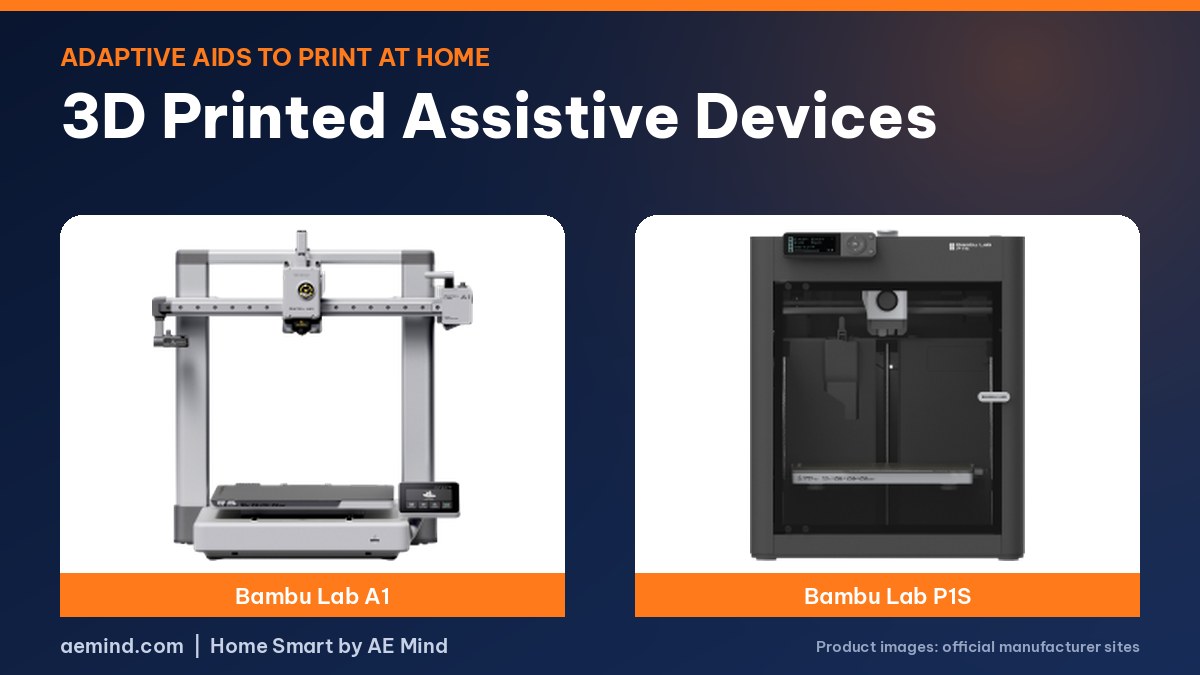
| Printer | Price (Amazon, Oct 16, 2026) | Why it fits | Link |
|---|---|---|---|
| Bambu Lab A1 | $299.99 | Reliable and easy to use | Check price |
| Bambu Lab P1S Combo | $549.00 | Enclosed; PETG and TPU | Check price |
| Bambu Lab A1 mini | $249.00 (LED lamp kit bundle) | Small aids on a budget | Check price |
What YouTube Creators Found About 3D Printed Assistive Devices
These are findings from popular YouTube videos, paraphrased from their transcripts and credited. They are the creators’ experiences and claims, not my test results.
- EquipMeOT (EquipMeOT: “3D Printed Adaptive Equipment | How to Get Started and What to Know!”), an occupational therapist and her husband, say print-in-place designs are the simplest adaptive equipment to make. They point people without printers to local libraries and makerspaces, warn PLA can warp in a hot car, and print parts that take force, like a seatbelt aid, in PETG.
- PrintLab (PrintLab: “13 Tips for Designing 3D Printed Assistive Technology”) urges designers to get to know the person and their routines, personalize designs, and share files open source so others can remix them.
- Michigan Tech researchers (via Medgadget: “Low-Cost 3D-Printed Adaptive Aids for Arthritis Patients”) designed printable aids for arthritis. They priced one pill cutter at $23.75 online versus $1.27 printed, which they called a 95% saving.
- On Reddit, makers share utensil aids for weak grip and key turners that users said helped with arthritis and tendonitis, with warnings that too much leverage can snap a key.

Designing Assistive Technology

Frequently Asked Questions
What assistive devices can I 3D print?
Utensil grips, key turners, openers, pen grips, card holders, switch adapters and more.
Are printed aids safe?
For low-risk daily tasks with good fit. They are not certified medical devices.
Where do I find files?
Open-source assistive tech projects, MakerWorld and Printables.
What filament?
PLA for light use, PETG for force, TPU for soft grips.
Sources
- EquipMeOT: “3D Printed Adaptive Equipment”
- PrintLab: “13 Tips for Designing 3D Printed Assistive Technology”
- Medgadget: “Low-Cost 3D-Printed Adaptive Aids for Arthritis Patients”
- r/disability: Utensil eating aid
- r/functionalprint: Key turners
- Amazon product listings for the printers linked above, October 16, 2026
Related: Useful Things to 3D Print for Your Home | 3D Prints for the Kitchen | How to 3D Print Replacement Parts | PLA vs PETG for Beginners
Notes and disclosure
Note: Printer prices come from Amazon listings on October 16, 2026 and change often. The ideas below come from popular YouTube creators and Reddit threads, credited where used. My own hands-on results will be added after my planned test prints.
Affiliate Disclosure: If you purchase an item through the links on this page, I may receive a commission, at no additional cost to you. Thank you for supporting the channel.