
3D printed screws are far stronger when printed on their side: a 1/2 in screw printed that way handled about twice the torque, around 145 in-lb, according to Sanford Prime, a YouTube channel that torque-tested printed screws.
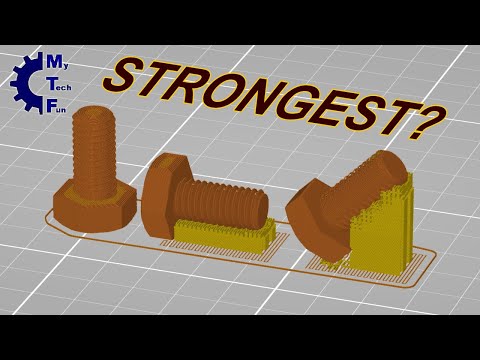
My Tech Fun, a YouTube channel that tests printed bolts from M6 to M12, also found horizontal bolts much stronger than vertical ones, and later cut them flat on one side so they print without supports.
This post covers printing the screw itself. For threads in parts, nuts and inserts, see my 3D printed threads, nuts and bolts guide.
When 3D Printed Screws Make Sense
Prices checked on Amazon Oct 16, 2026. I may earn a commission from links, at no cost to you.
- Custom or very large sizes you can’t buy, like big adjusters and knobs
- Non-metal needs: plastic-only assemblies, toys, display pieces
- Quick prototypes before ordering hardware
How to Print Stronger 3D Printed Screws
| Setting | What creators found |
|---|---|
| Orientation | Lying flat (horizontal) is much stronger than standing up, but needs supports or a flat-cut design |
| Walls | Thicker walls added more torque strength than infill did |
| Clearance | Add about 0.1 to 0.3 mm or chase the threads with a die |
| Material | PLA is stiff; PETG handles shock and long-term load better |
3D Printed Screws vs Metal Screws
A steel screw is far stronger and costs cents. Print a screw only when the size, shape or material is what you need. For screws driven into prints, the hole size matters most; see 3D printed hardware.
| Use | Filament | Why |
|---|---|---|
| Indoor, light load | PLA | Stiff and easy, but creeps under constant load |
| Constant load, bumps, flex | PETG | Tougher; resists creep and impact better |
| Hot garage, car, outdoors | ASA | Heat and UV resistant; needs an enclosed printer |
| Grip, soft contact | TPU | Rubber-like |
Safety: 3D printed hardware is not rated like store-bought hardware. Never use it where a failure could injure someone or damage something valuable: overhead loads, TVs, cabinets, ladders or anything you climb on.
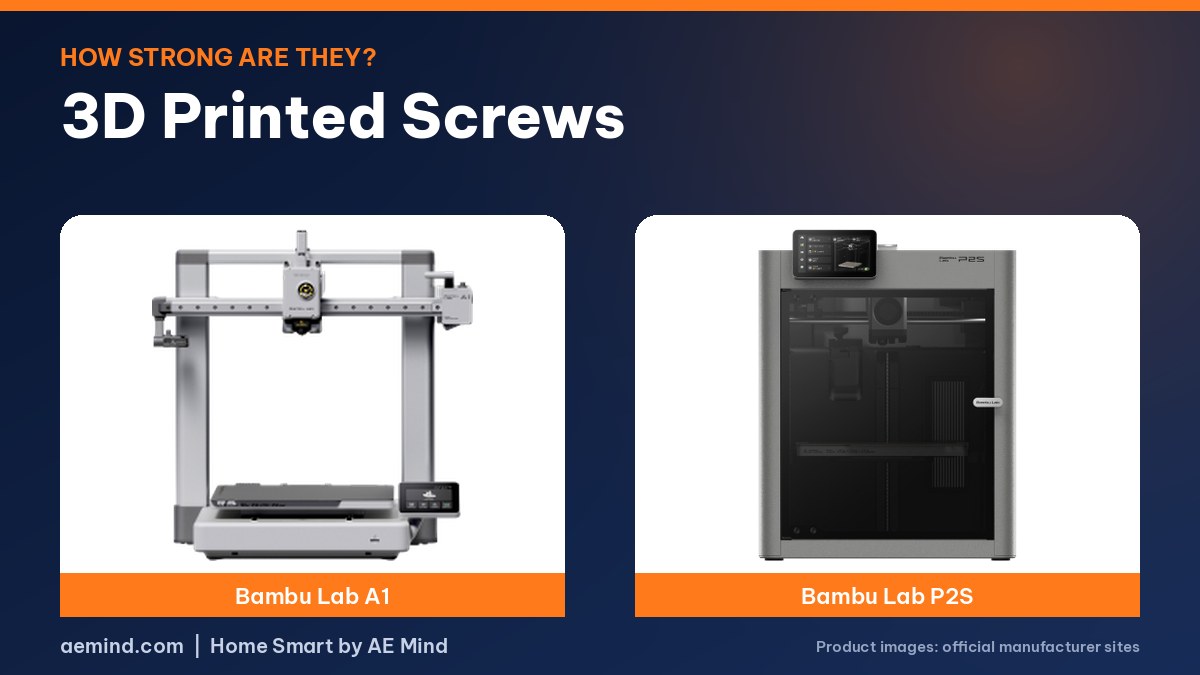
Best Printers for Precise Screws
| Printer | Price (Amazon, Oct 16, 2026) | Why it fits | Link |
|---|---|---|---|
| Bambu Lab P1S Combo | $549.00 | Enclosed: handles PETG and ASA hardware | Check price |
| Bambu Lab A1 | $299.99 | Accurate auto-calibration for good-fitting parts | Check price |
| Elegoo Centauri 2 Combo | $328.99 | Enclosed CoreXY with 4-color at a lower price | Check price |
What YouTube Creators Found About 3D Printed Screws
These are findings from popular YouTube videos, paraphrased from their transcripts and credited. They are the creators’ experiences and claims, not my test results.
- Sanford Prime (Sanford Prime: “Testing 3D Printed Screw Torques Until Failure with Results”) torque-tested a 1/2 in hex screw with different wall thicknesses and infills. In his final test, he printed the same screw on its side so the layers ran along the screw’s axis. It handled about twice the torque, around 145 in-lb by his reading.
- My Tech Fun (My Tech Fun: “3D printing bolt and thread in horizontal or vertical position – strength test”) tested printed bolts from M6 to M12. He found horizontally printed bolts were much stronger than vertical ones, which disappointed him because horizontal printing needs supports. He usually adds about 0.1 mm of clearance before chasing the threads with a die.
- My Tech Fun followed up (My Tech Fun: “Testing horizontally 3D printed bolts without supports”) with horizontal bolts cut flat on one side so they print without supports. He noted that CAD library threads often have no clearance by default.

Horizontal vs Vertical Bolts
Frequently Asked Questions
Are 3D printed screws strong?
Stronger than expected when printed horizontally with thick walls, but far weaker than steel.
Why won’t my printed screw thread in?
No clearance. Add 0.1 to 0.3 mm in CAD or clean the threads with a die.
Best orientation for a printed screw?
On its side, so layers run along the screw. Use supports or a flat-cut design.
PLA or PETG for screws?
PLA for stiffness and short-term strength, PETG for parts under long-term load or shock.
Sources
- Sanford Prime: “Testing 3D Printed Screw Torques Until Failure”
- My Tech Fun: “3D printing bolt and thread in horizontal or vertical position”
- My Tech Fun: “Testing horizontally 3D printed bolts without supports”
- Made with Layers (Thomas Sanladerer): “A better way to add threads to your 3D prints”
- Amazon product listings for the printers linked above, October 16, 2026
Related: 3D Printed Threads, Nuts and Bolts | How to 3D Print Replacement Parts | PLA vs PETG for Beginners | Bambu Lab A1 Review
Notes and disclosure
Note: Printer prices come from Amazon listings on October 16, 2026 and change often. The ideas below come from popular YouTube creators and Reddit threads, credited where used. My own hands-on results will be added after my planned test prints.
Affiliate Disclosure: If you purchase an item through the links on this page, I may receive a commission, at no additional cost to you. Thank you for supporting the channel.