
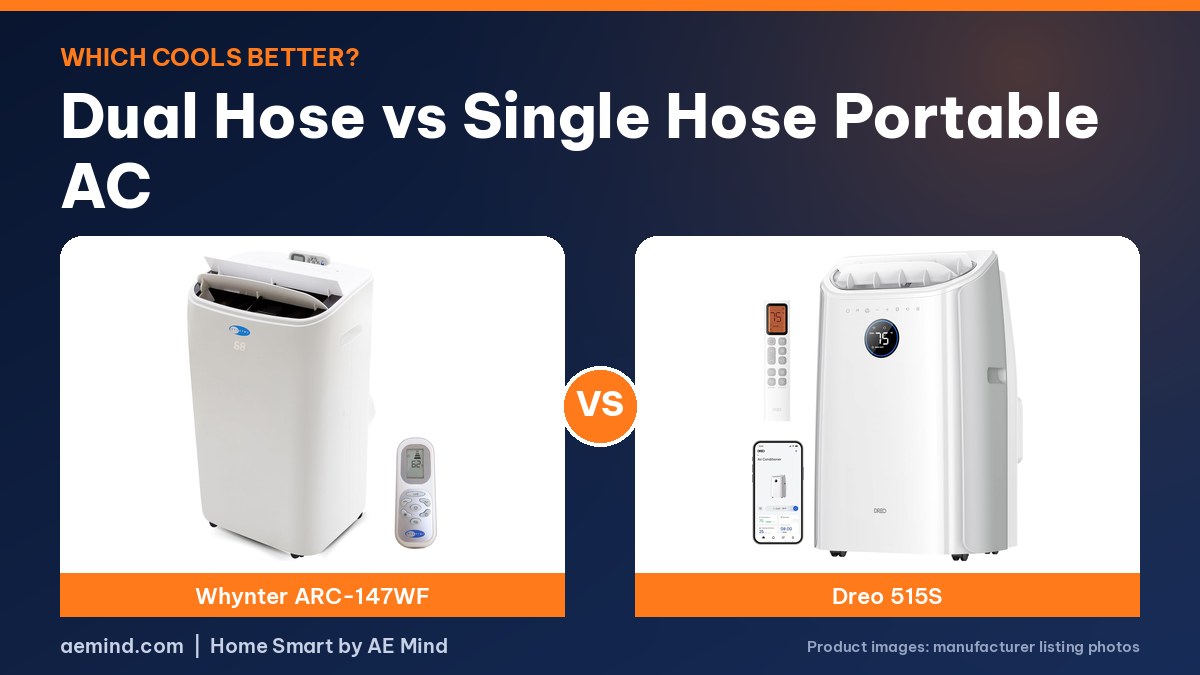
In the dual hose vs single hose portable air conditioner debate, single-hose units lose roughly 25% of their effective cooling because they exhaust air you already cooled and pull warm air back in, according to Technology Connections, an engineering-explainer YouTube channel with more than 10 million views on its portable AC video.
A dual-hose design pulls outside air to cool the condenser and sends it back out through a second hose, which gives the best efficiency and fastest cooling, according to Silver Cymbal, which has used a dual-hose Midea Duo for two years. Prices were checked on Amazon October 16, 2026.
Dual hose vs single hose portable air conditioner: models compared
Prices checked on Amazon Oct 16, 2026. I may earn a commission from links, at no cost to you.
| Whynter ARC-147WF (14,000 BTU) | Dreo 515S (12,000 BTU ASHRAE) | BLACK+DECKER BPACT10WT | |
|---|---|---|---|
| Price (Oct 16, 2026) | $459.99 | $449.99 | $319.99 |
| Cooling capacity | 14,000 BTU (listed) | 12,000 ASHRAE / 8,000 SACC (listed) | 10,000 ASHRAE / 5,550 DOE (listed) |
| Power draw | Not listed on Amazon | 1,500 W (listed) | 1,220 W (listed) |
| Hose | Dual hose | Single hose, window kit included | Single hose, window kit included |
| Extras | 51 dBA listed; HEPA and carbon filter; auto drain | Self-evaporating (drain-free) design; 45 dB claimed; Alexa, Google, Siri | Follow Me remote; rooms up to 450 sq ft (listed) |
| Buy | Check price | Check price | Check price |
Why single-hose units lose cooling
Technology Connections explained that a single-hose unit sucks in room air, blows it across the condenser and pushes it outside. That creates negative pressure that pulls warm air in from elsewhere, so an 8,000 BTU unit may move only about 6,000 BTU. Newer SACC ratings account for this loss. LDSreliance, a preparedness YouTuber who logged power use, found his single-duct portable and a window unit used nearly the same kWh per BTU over three hot days, but noted the negative-pressure effect still cuts real cooling.
When dual hose is worth it
- Hot rooms such as attics: Silver Cymbal cools an approximately 800 sq ft attic room with a 14,000 BTU dual-hose unit.
- Long run times: less wasted cooled air means less runtime for the same comfort.
- Pick: the Whynter ARC-147WF (14,000 BTU) ($459.99) is a dual-hose model with a listed 51 dBA and a HEPA and carbon filter.
When single hose is fine
For a small bedroom used a few hours a night, a single-hose unit like the Dreo 318S (8,000 BTU ASHRAE) is simpler to set up. Seal the window kit well and close the door. Compare the SACC rating, not the bigger ASHRAE number.

Video: Technology Connections: “Portable Air Conditioners – Why you shouldn’t like them”. Embedded with credit; the findings are the creator’s own.

Video: Silver Cymbal: “Is the Midea DUO Smart Inverter Portable Air Conditioner Worth It?”. Embedded with credit; the findings are the creator’s own.
Frequently Asked Questions
Is a dual-hose portable AC better than single hose?
Generally yes for efficiency and speed, according to Silver Cymbal and Technology Connections.
Why are most portable ACs single hose?
Technology Connections noted dual-hose models have become a rare part of the market; most sold are single hose.
What is SACC?
A rating that accounts for hose losses, so it is lower than the ASHRAE number and better for comparing portable units.
Is a window unit better than a portable AC?
Technology Connections says a window unit is more efficient and cheaper to run if you can use one.
Sources
- Amazon product listings for the products linked above, checked October 16, 2026
- Technology Connections: “Portable Air Conditioners – Why you shouldn’t like them”
- Silver Cymbal: “Is the Midea DUO Smart Inverter Portable Air Conditioner Worth It?”
- LDSreliance: “Energy Consumption Tested & Compared – Window vs Portable Air Conditioners”
Related: Portable Air Conditioner for Renters | Dreo Portable Air Conditioner Review | Portable Air Conditioner Running Cost | Portable Air Conditioner Without a Window
Notes and disclosure
Note: Prices come from Amazon listings checked on October 16, 2026. Prices change often, so check the current listing. BTU ratings, wattage and noise figures are the manufacturers’ listed numbers unless a reviewer is credited. Running-cost figures are worked examples at the U.S. average residential electricity price, so use your own rate from your power bill. Test results and tips quoted above come from the YouTube creators credited in each section; they are their findings, not hands-on claims from me.
Affiliate Disclosure: If you purchase an item through the links on this page, I may receive a commission, at no additional cost to you. Thank you for supporting the channel.