
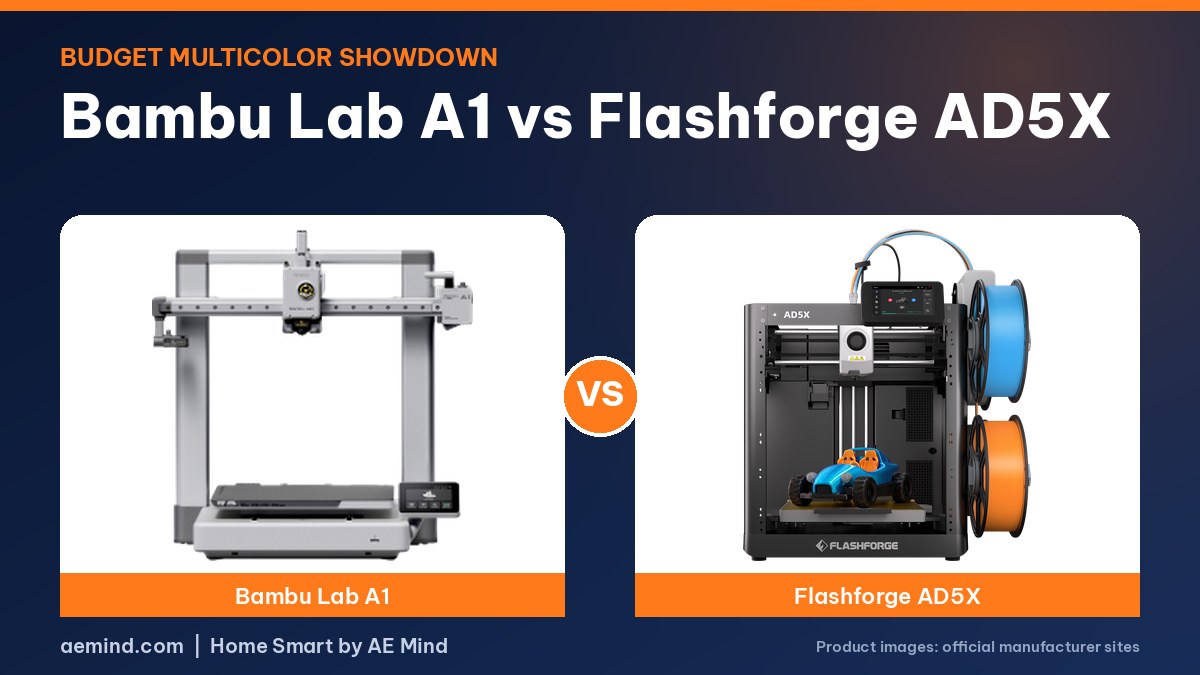
In a side-by-side multicolor test, the Flashforge AD5X wasted less filament and finished faster than the Bambu Lab A1: 6.5 g of purge waste in about 40 minutes, against 8.3 g in about 49 minutes, according to Figure Feedback. The YouTube channel printed the same keychain with the same filaments on both machines and weighed every scrap.
The A1’s print looked sharper, Figure Feedback said. Price is the other difference: on Oct 17, 2026, the AD5X listed at $349 on Amazon with four-color printing built in, while the A1 listed at $299.99 and needs Bambu’s AMS lite for multicolor. The A1 also has the bigger 256 mm build volume, against 220 mm on the AD5X.
Bambu Lab A1 vs Flashforge AD5X: Test Results
Prices from Amazon at time of writing. I may earn a commission from links, at no cost to you.
| Test | Bambu Lab A1 | Flashforge AD5X | Source |
|---|---|---|---|
| Purge waste, same multicolor keychain | 8.3 g | 6.5 g | Figure Feedback |
| Finished model weight | 5.3 g | 5.2 g | Figure Feedback |
| Print time, same keychain | About 49 min | About 40 min | Figure Feedback |
| Print quality | Sharper, more contrast | Slightly more faded; reviewer suspects the textured gold PEI plate | Figure Feedback |
| Print time, a roughly 1-hour print | About 7 min faster | Slower, mainly from calibration time | CaliWoodConnect |
Figure Feedback stressed that it tested one model and that “your experience may vary.” The two reviewers’ time results point in opposite directions, so treat speed as a wash.
Side-by-Side Specs
| Spec | Bambu Lab A1 | Flashforge AD5X |
|---|---|---|
| Price (Amazon, Oct 17, 2026) | $299.99 | $349.00 |
| Multicolor | Needs AMS lite (sold separately or as the A1 Combo) | 4-color IFS included |
| Build volume | 256 × 256 × 256 mm | 220 × 220 × 220 mm |
| Motion | Open bed-slinger | CoreXY, all-metal frame |
| Speed | 500 mm/s, 10,000 mm/s² accel | 600 mm/s travel, 300 mm/s print, 20,000 mm/s² accel |
| Hotend / bed | 300°C / 100°C | 300°C / 110°C |
| Materials | PLA, PETG, TPU, PVA ideal; ABS/ASA not recommended (Bambu) | See Flashforge listing |
| Camera | Built in (low frame rate), per Bambu | Add-on camera kit |
| Noise | Silent mode under 48 dB, per Bambu | — |
| Buy | Check price | Check price |
Specs come from Bambu Lab’s A1 tech-spec page and Flashforge’s AD5X product page.
Multicolor Waste: Why It Matters
Every color change purges filament, and on small multicolor prints the purge can outweigh the part. In Figure Feedback’s test, the A1 made 8.3 g of waste for a 5.3 g keychain (Figure Feedback, “Bambu Lab A1 vs. Flashforge AD5X – Which Printer Wastes More Filament?”). FauxHammer said waste is why many people print parts in separate colors and glue them together. It suggests reducing purge amounts in the slicer or purging into infill to cut waste and time (FauxHammer, “Yet Somehow It’s Good? – Flashforge Adventurer AD5X Review”). Flashforge sent the AD5X for FauxHammer’s review.
Bambu Lab A1: Who It’s For
- Bigger 256 mm prints
- The sharpest-looking result in Figure Feedback’s test
- Full auto calibration, active flow-rate compensation and a one-clip quick-swap nozzle (listing)
- Start single-color now and add the AMS lite later
- Quiet rooms: Bambu lists a silent mode under 48 dB, and calibration runs automatically before every print
- LAN mode for local-only printing (Bambu)
At $299.99 without the AMS lite, the A1 costs less up front. Compare the A1 Combo price with the AD5X on the day you buy if you want multicolor from the start. See the Bambu Lab A1 on Amazon.
Flashforge AD5X: Who It’s For
- Four-color printing in the box at $349
- A fast CoreXY frame. 3D Print Dood called the AD5X “kind of ridiculous for the value” and one of the cheapest automatic multicolor printers (3D Print Dood, “The 4 BEST Budget 3D Printers – Find the Right One for YOU!”)
- Tight shelves. CaliWoodConnect said its built-in filament system saves a lot of vertical space over the A1 with AMS lite, though it is slightly wider (CaliWoodConnect, “Is Flashforge AD5X better than Bambu A1 (Honest Review)”)
- Lower purge waste in Figure Feedback’s test
FauxHammer noted it has no camera as standard, and Flashforge’s enclosure kit asks you to print your own parts, ideally in a heat-resistant material like ABS (FauxHammer, “Yet Somehow It’s Good? – Flashforge Adventurer AD5X Review”). See the Flashforge AD5X on Amazon.
Which One Should You Buy?
- Choose the Flashforge AD5X if you want four colors now for $349, a CoreXY frame and less purge waste.
- Choose the Bambu Lab A1 if you want the bigger build volume and sharper prints, or want to start with single color and add the AMS lite later.
How This Comparison Was Researched
I have not tested these printers myself. Test results come from Figure Feedback and CaliWoodConnect, and design notes from FauxHammer and 3D Print Dood. Specs come from the makers’ pages, and prices from Amazon at time of writing. Flashforge sent the filament spools used in CaliWoodConnect’s video.
Video: Figure Feedback, “Bambu Lab A1 vs. Flashforge AD5X – Which Printer Wastes More Filament?”
Frequently Asked Questions
Does the Flashforge AD5X come with multicolor?
Yes. Its 4-color Intelligent Filament System is included.
Which wastes less filament in multicolor prints?
In Figure Feedback’s test, the AD5X: 6.5 g vs 8.3 g on the A1 for the same model.
Which has the bigger build volume?
The A1, at 256 mm cubed, vs 220 mm cubed for the AD5X.
Does the AD5X have an enclosure?
Not out of the box. 3D Print Dood says it has a frame around it, and you can add an enclosure.
Sources
- Figure Feedback, “Bambu Lab A1 vs. Flashforge AD5X – Which Printer Wastes More Filament?”
- CaliWoodConnect, “Is Flashforge AD5X better than Bambu A1 (Honest Review)”
- FauxHammer, “Yet Somehow It’s Good? – Flashforge Adventurer AD5X Review”
- 3D Print Dood, “The 4 BEST Budget 3D Printers – Find the Right One for YOU!”
- Bambu Lab A1 tech specs
- Amazon listings: Bambu Lab A1, Flashforge AD5X (from Amazon at time of writing)
Related: Best Budget Multicolor 3D Printer | Bambu Lab A1 vs P1S | Best 3D Printer Under $500
Notes and disclosure
Note: Prices come from Amazon listings at time of writing. Specs come from the makers’ pages. Test results are credited to the reviewer who reported them.