
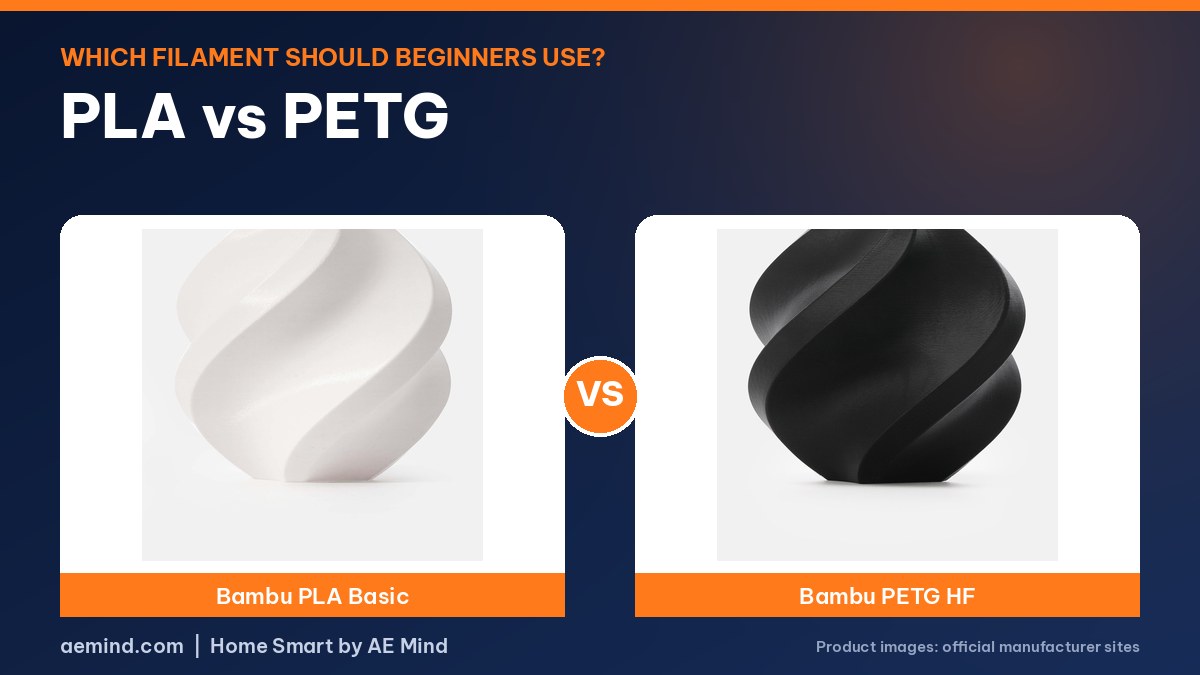
In the PLA vs PETG choice, beginners should start with PLA. It was the stronger and stiffer of the two in lab-style tests by CNC Kitchen, a YouTube channel and blog that load-tests 3D printing materials. Switch to PETG for parts that go outside, sit in a hot car or need to bend without snapping.
In those tests, a PLA hook held 73 kg before giving way, against 55 kg for PETG. But the PLA hook failed suddenly, while the PETG hook “never snapped through and just stretched and stretched,” CNC Kitchen said. PLA also started to give at 60°C, while PETG lasted until about 80°C.
Below are the test numbers, how the two print, which to use for common projects, and how to keep both dry.
PLA vs PETG: Test Results Side by Side
Prices from Amazon at time of writing. I may earn a commission from links, at no cost to you.
| Test (CNC Kitchen, Prusament) | PLA | PETG | What it means |
|---|---|---|---|
| Hook printed flat, maximum load | 73 kg | 55 kg | PLA carries more static load |
| Hook printed standing (layer adhesion) | 40 kg | 25 kg | Both lose about half their strength across layers |
| Stiffness (bending modulus) | 3,300 MPa | 1,900 MPa | PETG has about 70% of PLA’s stiffness, so it flexes more |
| Notched impact strength | 5 kJ/m² | 8.6 kJ/m² | PETG absorbs a sharp hit somewhat better |
| Starts to soften in the oven | 60°C | 80°C | PETG survives a warm car or sunny window far better |
| Cost per metre (Prusament, 2020) | 7.5 cents | 9 cents | PETG costs a little more |
CNC Kitchen printed every sample on a stock Prusa MK3S with stock profiles and noted that every brand behaves a little differently, because “there isn’t just one PLA, one PETG.” Treat the numbers as a guide to how the two materials compare, not exact figures for your spool (CNC Kitchen, “Comparing PLA, PETG & ASA – feat. Prusament”).
Strength vs Toughness: Why Both Can Be Called “Stronger”
PLA is stronger and stiffer: it takes more load before it fails and bends less on the way there. PETG is tougher: it bends and stretches before it gives up, so a part made from it tends to deform instead of cracking.
3D Print Dood, “PLA vs PETG Filament – Everything You NEED TO KNOW” describes PLA as hard and stiff, which is great for precise, rigid parts but “more brittle, which can lead to cracking or breaking under stress.” PETG, the channel says, is better for parts that need to flex or absorb shock, like clips, springs or outdoor items, because it will “flex instead of crack under pressure.”
One surprise in CNC Kitchen’s data: PETG’s stretchiness under slow loads didn’t carry over to a sudden hit. It scored only a little better than PLA in the impact test. For something like a drone frame, CNC Kitchen said it would still pick PLA over PETG for its strength and stiffness (CNC Kitchen, “Comparing PLA, PETG & ASA – feat. Prusament”).
Heat Resistance: The Biggest Practical Difference
3D Print Dood puts PLA’s glass transition temperature at about 50 to 60°C, which makes it a poor fit for a car dashboard or other parts near heat. PETG’s is higher, about 70 to 80°C (3D Print Dood, “PLA vs PETG Filament – Everything You NEED TO KNOW”).
CNC Kitchen’s oven test matched that. Under a small weight, PLA began to sag at 60°C and failed about 5°C later. PETG held until about 80°C, then failed about 5°C after that. If a part will sit in a parked car, a greenhouse or direct summer sun, PETG is the safer of the two.
How PLA and PETG Print
| PLA | PETG | |
|---|---|---|
| Nozzle temperature in CNC Kitchen’s tests | 215°C | 250°C |
| Part cooling fan | 100% | 30 to 50% |
| Stringing | Low | A little more, common for PETG |
| Warping | Minimal | Low |
| Color and specialty options | Widest: silk, wood, glow-in-the-dark and more | Fewer specialty options |
PLA is generally easier: it prints at lower temperatures, sticks well to the bed and barely warps, so it works on printers without an enclosure. PETG can be more challenging because it is sticky and tends to string and ooze, 3D Print Dood says. It needs higher temperatures and some tuning, but once tuned it has excellent layer adhesion (3D Print Dood, “PLA vs PETG Filament – Everything You NEED TO KNOW”).
Both print on open-frame machines. Neither needs an enclosed printer the way ABS or ASA usually does.
Which Filament for Which Project?
| Project | Pick | Why |
|---|---|---|
| Models, figurines, decor, cosplay detail | PLA | Best surface finish and the most colors |
| Prototypes and fit tests | PLA | Cheap, fast, accurate |
| Drawer organizers and bins | PLA | Stiff and plenty strong indoors |
| Clips, snap fits and living hinges | PETG | Flexes instead of cracking |
| Car accessories | PETG | Survives cabin heat that softens PLA |
| Garden, planters and outdoor parts | PETG | Better UV and heat resistance |
| Wall hooks under constant load | PETG | Less brittle; add walls for strength |
For heat above what PETG can handle, CNC Kitchen’s ASA samples lasted until about 110 to 120°C, but ASA prints best in an enclosed printer (CNC Kitchen, “Comparing PLA, PETG & ASA – feat. Prusament”).
Keep Your Filament Dry
Most filaments are hygroscopic, meaning they “soak up water like a sponge,” according to 3D Print Dood, “What is a Filament Dryer? And Do You Really Need It?”. The channel says PLA isn’t as sensitive, so you can often get by without a dryer, but PETG, TPU and nylon absorb moisture quickly, and a dryer can be “a total game changer” for them. Moisture shows up as stringing, popping and rough surfaces.
Open spool holders like the A1’s AMS lite leave filament exposed to room humidity, while the enclosed AMS used with the Bambu Lab P1S Combo can hold desiccant (FauxHammer, “One Clear Winner – Bambu Labs A1 Mini Vs A1 Vs P1S Vs P1P Vs X1”).
Printers That Handle Both
| Printer | Price (Amazon, Oct 16, 2026) | Why it fits | Link |
|---|---|---|---|
| Bambu Lab A1 | $299.99 | Open frame; prints PLA and PETG well | Check price |
| Bambu Lab P1S Combo | $549.00 | Enclosed; AMS holds desiccant and adds ABS and ASA | Check price |
Bambu Lab lists PLA, PETG, TPU and PVA as ideal materials for the A1, and ABS and ASA as not recommended. Compare more options in our beginner printer guide.
Video: 3D Print Dood, “PLA vs PETG Filament – Everything You NEED TO KNOW”. Embedded with credit; the findings are the creator’s own.
Frequently Asked Questions
Is PETG stronger than PLA?
Not in static strength. In CNC Kitchen’s tests PLA held 73 kg against PETG’s 55 kg. PETG is tougher, though: it bends and stretches instead of snapping.
Can PLA be used outdoors?
For short-term use, yes. PETG is better outdoors because it handles heat and UV better.
Will PLA melt in a hot car?
It can deform. PLA started to soften at 60°C in CNC Kitchen’s test, and a parked car in summer can get hotter than that. Use PETG or ASA.
Is PETG harder to print than PLA?
A little. It needs a hotter nozzle, less cooling and some tuning to control stringing.
Can the Bambu Lab A1 print PETG?
Yes. Bambu Lab lists PETG as an ideal material for the A1.
Do I need to dry PLA?
Often not. PETG, TPU and nylon benefit more from a dryer.
Sources
- CNC Kitchen, “Comparing PLA, PETG & ASA – feat. Prusament”
- 3D Print Dood, “PLA vs PETG Filament – Everything You NEED TO KNOW”
- 3D Print Dood, “What is a Filament Dryer? And Do You Really Need It?”
- FauxHammer, “One Clear Winner – Bambu Labs A1 Mini Vs A1 Vs P1S Vs P1P Vs X1”
- Bambu Lab A1 tech specs
- Amazon product listings for the printers linked above, October 16, 2026
Related: Bambu Lab A1 Review | Best 3D Printer for Beginners | Best Budget Multicolor 3D Printer | Do You Need a Filament Dryer?
Notes and disclosure
Note: Test figures come from CNC Kitchen’s published results using Prusament filament; other brands vary. Printer prices come from Amazon listings on October 16, 2026 and change often. The findings are the credited creators’ own, not hands-on claims from me.