
A 3D printed clamp is strong enough for light work such as small glue-ups, electronics and holding parts, if you follow the designer’s settings of about five walls and 30% infill, according to 3D PrintSmith, a YouTube channel that built a trending clamp by Lobo CNC in PETG, PLA and TPU (3D PrintSmith, “Is a 3d printed clamp strong enough?”). For heavy woodworking pressure, steel clamps remain the better choice.
Printed vises can be surprisingly capable when the load runs along the layers. Make.Test.Battle, a maker channel, designed a screwless drill-press vise whose jaw pulls down and forward to stay parallel, then reprinted its highest-load parts at 100% infill (Make.Test.Battle, “3D Printed Screwless Vise”). Below are clamp and vise types, settings creators used and material choices.
Types of 3D Printed Clamps and Vises
Prices from Amazon at time of writing. I may earn a commission from links, at no cost to you.
| Clamp | Good for | Tip |
|---|---|---|
| Spring clamps | Gluing small parts, holding cloth | PETG spring; TPU tips |
| Mantis or PCB clamps | Electronics and models | Small and gentle |
| Toggle and cam clamps | Jigs and fixtures | Metal pins at pivots |
| Corner clamps | Frames and boxes | Print reference faces flat |
| Drill press or bench vise | Holding work for drilling | Orient so force doesn’t shear layers |
| Soft jaws | Protecting parts in a metal vise | TPU or PLA |
3D Printed Clamp Test: Lobo CNC Design
3D PrintSmith printed the spring, pin and lever in PETG, the handles in matte PLA and the tips in gray TPU. He followed the designer’s advice of about five walls and 30% infill and noted that assembly order matters (3D PrintSmith, “Is a 3d printed clamp strong enough?”).
Teaching Tech, a YouTube channel that tests printers and workshop prints, showed the Mantis Clamp by Zubirio, which held a PCB and its own weight while staying easy to open, and named a bench vise by Snakes as a favorite (Teaching Tech, “12 more 3D printed tools you need for your workshop”).
3D Printed Vise Builds: What Creators Learned
Make.Test.Battle’s screwless vise uses a pin that drops into cutouts along a track and a bolt that pulls the jaw toward a pivot (Make.Test.Battle, “3D Printed Screwless Vise”). Lessons from the build:
- Keep the jaws parallel. Pulling the jaw down onto the track as well as forward stops it tilting up, so work can’t pop out the top.
- Orient for the load. The main body was printed so clamping force presses along the layers rather than shearing them; he couldn’t pull the bars apart by hand.
- Big parts take time. The main body took about 10 hours, his longest print at the time, with 25% triangular infill in Cura.
- Beef up small, loaded parts. For version two he reprinted the pivot and pin at 100% infill because they carried the most load in a small area.
- Watch overhang direction. The slicer printed one overhang lengthwise, which sagged and left a rough side.
PixelForge Lab, a 3D printing channel, built a vise from three materials: ASA for the frame and jaw, ABS for the threaded rod, guide rods and clips, and TPU for grip pads (PixelForge Lab, “3D Printed Vise Showdown: ASA, ABS & TPU in a Multi-Material Build!”). To print ABS, he swapped to a smooth plate, preheated the bed and nozzle and closed the printer’s lid to hold heat. His first ASA parts showed layer artifacts, which he blamed on not drying new filament; after four hours in a dryer, later prints came out clean.
Fast-Action Clamps and Soft Jaws
John Heisz of I Build It, a woodworking channel, built a fast-acting clamp in wood with threaded rod and shared free templates and 3D print files (John Heisz – I Build It, “Powerful Clamp Action FAST!”).
Printed soft jaws in TPU or PLA protect finished parts in a metal vise. Industrial companies like Stratasys and Markforged print soft jaws for machine shops, but in engineering materials.
Print Settings for Strong 3D Printed Clamps
| Setting | Recommendation | Source |
|---|---|---|
| Walls | About 5 | Lobo CNC via 3D PrintSmith |
| Infill | About 30%; 100% for small pivots and pins | 3D PrintSmith; Make.Test.Battle |
| Orientation | Force along layers, not across | Make.Test.Battle |
| Springs and levers | PETG | 3D PrintSmith |
| Frames in a hot shop | ASA (dry it first) | PixelForge Lab |
| Pads and tips | TPU | 3D PrintSmith; PixelForge Lab |
- Use metal pins and screws at pivots.
- Glue TPU pads if they sit loose, as PixelForge Lab did.
For big panel glue-ups, buy steel bar clamps and print accessories instead; see woodworking jigs.
Best Printers for 3D Printed Clamps
| Printer | Price (Amazon, Oct 16, 2026) | Why it fits | Link |
|---|---|---|---|
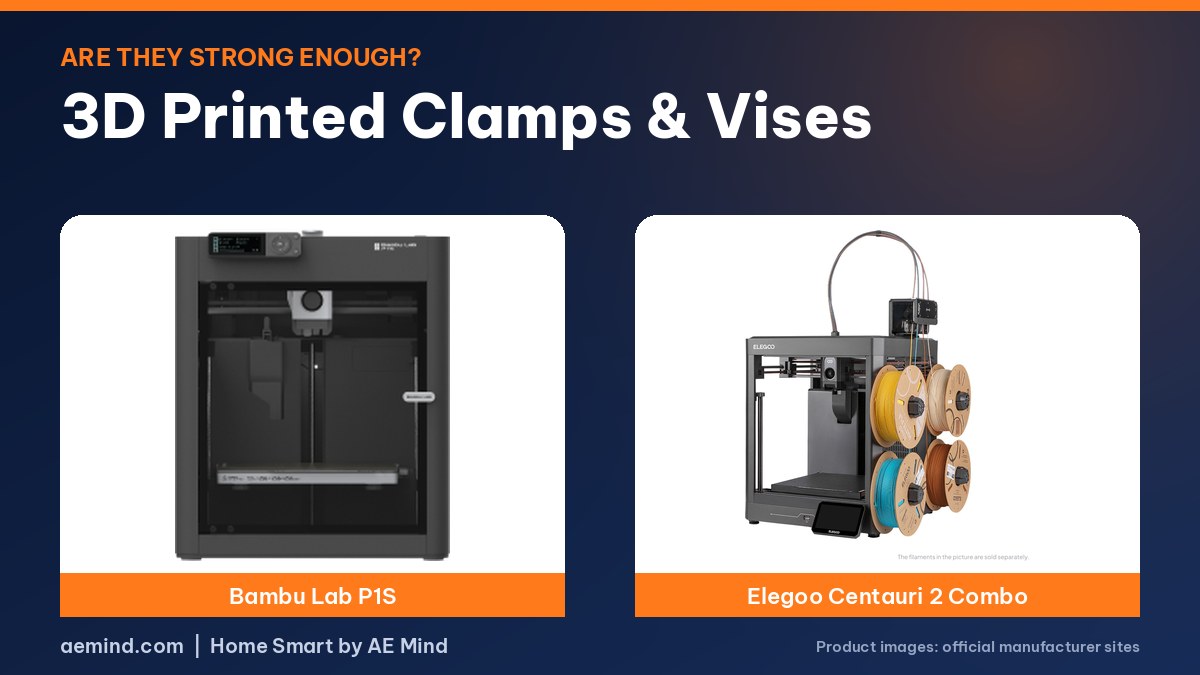
| Bambu Lab P1S Combo | $549.00 | Enclosed, so ASA and ABS parts are practical | Check price |
| Bambu Lab A1 | $299.99 | Great value for PLA, PETG and TPU parts | Check price |
| Elegoo Centauri 2 Combo | $328.99 | Enclosed CoreXY with 4-color at a lower price | Check price |
Video: 3D PrintSmith, “Is a 3d printed clamp strong enough?”. Embedded with credit; the findings are the creator’s own.
Video: Make.Test.Battle, “3D Printed Screwless Vise”.
3D Printed Clamps: Frequently Asked Questions
Are 3D printed clamps strong enough for woodworking?
For small glue-ups and holding, yes. For big panels, use steel bar clamps.
What filament is best for 3D printed clamps?
PETG for springs and levers, PLA for stiff handles, ASA for frames in a hot shop and TPU for soft tips.
What infill should a 3D printed clamp use?
About 30% with five walls, per the Lobo CNC design; Make.Test.Battle used 100% for small, high-load pivots.
Can I print vise soft jaws?
Yes. TPU or PLA jaws protect finished parts in a metal vise.
Why did my printed clamp snap?
Usually at the layer lines. Reorient the part so force runs along the layers, add walls or switch to PETG.
Sources
- 3D PrintSmith, “Is a 3d printed clamp strong enough?”
- Teaching Tech, “12 more 3D printed tools you need for your workshop”
- Make.Test.Battle, “3D Printed Screwless Vise”
- PixelForge Lab, “3D Printed Vise Showdown: ASA, ABS & TPU in a Multi-Material Build!”
- John Heisz – I Build It, “Powerful Clamp Action FAST!”
- Stratasys: “The Benefits of 3D Printed Soft Jaws”
- Amazon product listings for the printers linked above, October 16, 2026
Related: 3D Prints for Garage Organization | PLA vs PETG for Beginners | How to 3D Print Replacement Parts | Bambu Lab A1 vs P1S
Notes and disclosure
Note: Printer prices come from Amazon listings on October 16, 2026 and change often. Build details and settings come from the credited YouTube creators; I have not tested these clamps myself.