
3D printed fishing lures do catch fish when designed right, and solid lipless crankbaits avoid the slow water seepage that changes the action of many printed lures, according to Kenny of Upscale Lures, a YouTube channel that has printed and fished lures for more than six years (Upscale Lures, “5 Reasons To 3D Print Fishing Lures”). His 1.5 in solid lipless crankbait prints in about 21 minutes.
Hunter Vargo, a YouTube channel about outdoor experiments, and his brother caught a bass on a homemade printed bait (Hunter Vargo, “I Tricked Fish with a 3D Printer”). Anglers on Reddit recommend epoxy coats and say printed crankbaits work as well as bought blanks when the wire carries the load. Here is what works, the materials to use and how to get buoyancy right.
3D Printed Fishing Lures That Print Well
Prices from Amazon at time of writing. I may earn a commission from links, at no cost to you.
| Lure type | Why it prints well | Tip |
|---|---|---|
| Solid lipless crankbaits | No air pockets to take on water | Print and fish, no clear coat |
| Glide baits and jerkbaits | Easy to prototype shapes | Seal or swap out during the day |
| Topwater poppers | Hollow bodies float | Seal the body |
| Segmented swimbaits | Print-in-place joints | Test the action in a bucket |
| Molds for soft plastics or jig heads | Fast custom molds | Check the mold material’s heat limit |
Why Anglers 3D Print Fishing Lures
Upscale Lures gives five reasons (Upscale Lures, “5 Reasons To 3D Print Fishing Lures”):
- Print on demand: replace a snagged lure at home, so you can fish snag-heavy cover aggressively, and tailor colors to muddy or clear water.
- Print and fish: solid designs skip painting and clear coat.
- Multicolor printing: paint the lure digitally in the slicer for an identical finish every time. He layers colors behind each other to blend more natural hues, and calls this his favorite part.
- Fast prototyping: test in the morning, adjust the model and test the new version by sunset, and make shapes like a lure that stores its hooks inside behind a printed hinge door.
- Easier printers: auto bed leveling and power-loss recovery make modern machines far easier than early ones.
Buoyancy, Water and Sealing
Lures with air pockets, such as glide baits, jerkbaits and crankbaits, rely on buoyancy for their action. Upscale Lures says they start taking on water once cast, giving you about 15 minutes to an hour before the action is off; his simple fix is to bring spares and swap through the day (Upscale Lures, “5 Reasons To 3D Print Fishing Lures”). He calls drying filament a must, because it makes prints more water resistant, though never fully waterproof. In his longer guide, he showed that wet filament left gaps that foam poured into a lure seeped through, which dried filament mostly cured (Upscale Lures, “6 Years of 3D Printing Fishing Lures Experience In 34 Minutes”). He designs his own lures at 100% infill.
- PLA and PETG are denser than water; floating lures need hollow bodies or low infill.
- Add weights low in the belly, for example by pausing the print to insert them.
- Tune the action in a bucket before the lake.
- Run a through-wire so the hooks, not the plastic, take the load.
- Seal with epoxy or UV resin, or use a solid design.
Best Filament for 3D Printed Fishing Lures
Upscale Lures started with ABS six years ago but no longer uses it, calling it hard to print and smelly; he suggests trying PETG first (Upscale Lures, “6 Years of 3D Printing Fishing Lures Experience In 34 Minutes”). PLA works, especially for smaller lures, and comes in far more colors; he kept PLA lures in a hot truck on a Florida trip with no problems. His main pick is PETG, which is more impact resistant for thin tails and fins.
| Filament | Use it for |
|---|---|
| PLA | Cheap, takes paint, many colors; seal it for long life |
| PETG | Tougher and more impact resistant; Upscale Lures’ main choice |
| TPU | Soft-bodied experiments |
He recommends a 0.2 mm layer height as a starting point, stainless steel hardware so nothing rusts, and checking a file’s description and others’ results before printing, since many online models are untested prototypes (Upscale Lures, “6 Years of 3D Printing Fishing Lures Experience In 34 Minutes”). He also printed a 23 in glide bait in two pieces at 5% infill, a print of more than 100 hours.
Hunter Vargo’s Lake Test
Hunter Vargo and his brother Christian designed their own baits, then tried downloaded designs, a crawfish, a large flexible carp and a Benchy with a treble hook (Hunter Vargo, “I Tricked Fish with a 3D Printer”). His brother’s simple custom bait caught a bass. Some designs behaved unexpectedly: the Benchy sank and the carp floated on the surface, a reminder to test buoyancy first.
Best Printers for 3D Printed Fishing Lures
| Printer | Price (Amazon, Oct 16, 2026) | Why it fits | Link |
|---|---|---|---|
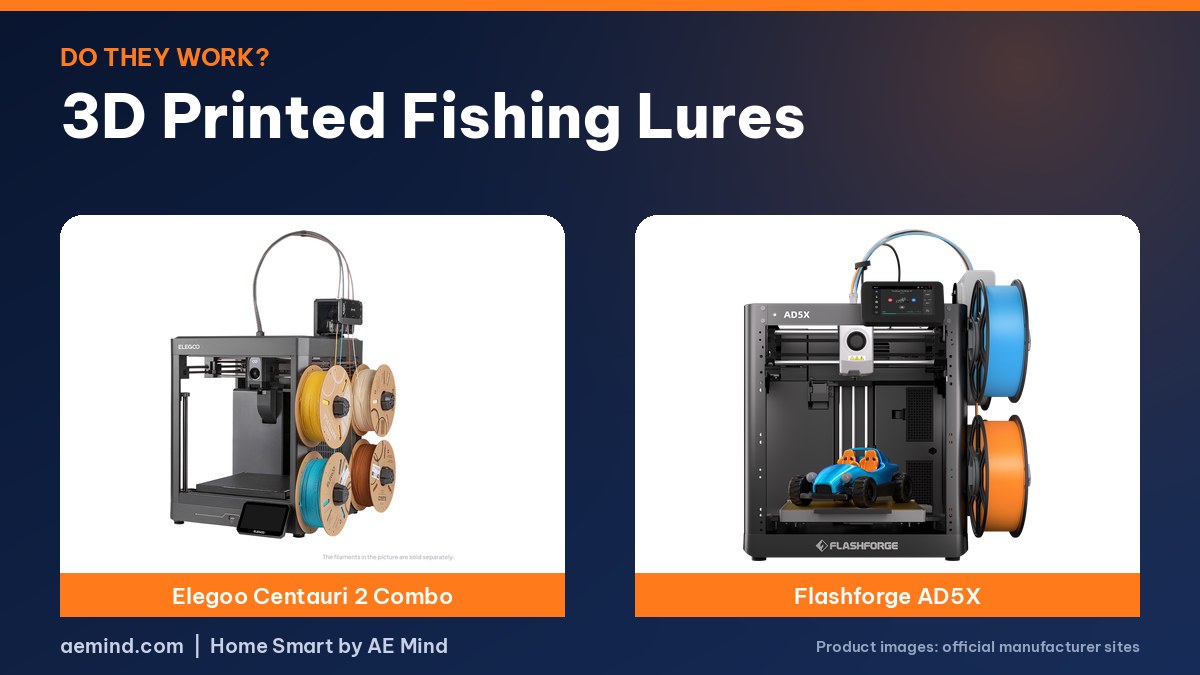
| Elegoo Centauri 2 Combo | $328.99 | 4-color: print painted-look lures | Check price |
| Flashforge AD5X | $349.00 | Budget 4-color | Check price |
| Bambu Lab P1S Combo | $549.00 | Enclosed; up to 16 colors with more AMS units | Check price |
Upscale Lures prints on a Bambu Lab X1 Carbon with AMS and says it about halves his print time versus his Prusa (Upscale Lures, “6 Years of 3D Printing Fishing Lures Experience In 34 Minutes”). For more options, see best budget multicolor 3D printer.
Video: Upscale Lures, “5 Reasons To 3D Print Fishing Lures”. Embedded with credit.
Video: Upscale Lures, “6 Years of 3D Printing Fishing Lures Experience In 34 Minutes”.
3D Printed Fishing Lures: Frequently Asked Questions
Do 3D printed fishing lures catch fish?
Yes. Upscale Lures and Hunter Vargo both caught fish on printed lures.
PLA or PETG for 3D printed fishing lures?
PETG is tougher; PLA is fine sealed or in solid designs.
How do I make a 3D printed lure float?
Use a hollow body or low infill; PLA and PETG sink when solid.
Do I need to seal 3D printed lures?
Usually, unless the design is solid. Drying filament first helps.
What layer height for fishing lures?
Upscale Lures suggests 0.2 mm as a starting point.
Sources
- Upscale Lures, “5 Reasons To 3D Print Fishing Lures”
- Upscale Lures, “6 Years of 3D Printing Fishing Lures Experience In 34 Minutes”
- Hunter Vargo, “I Tricked Fish with a 3D Printer”
- r/3Dprinting: Can I 3D print fishing lures?
- r/SurfFishing: 3D printed lures
- Amazon product listings for the printers linked above, October 16, 2026
Related: 3D Prints for the Garden | Best Budget Multicolor 3D Printer | PLA vs PETG for Beginners | Things to 3D Print for Camping
Notes and disclosure
Note: Printer prices come from Amazon listings on October 16, 2026 and change often. Lure results come from the credited YouTube creators and Reddit threads; I have not fished these lures myself.