
The best 3D prints for garden use are the things you can’t buy in the right size: self-watering planter inserts, seedling propagation trays, plant labels, hose adapters and grow light holders. Prusa 3D, the YouTube channel of printer maker Prusa Research, says the biggest advantage is making pots in exactly the shape and size you need (Prusa 3D, “Meaningful uses of 3D Printing in Gardening”). Outdoors, ASA and PETG hold up far better than PLA.
Hoocho, a YouTube channel about printable hydroponics, designed a self-watering seedling propagator that fits most print beds (Hoocho, “MINI 3D Printable Self Watering Seedling Propagation System”), and Practical Prints, a YouTube channel about useful prints, printed a planter, drip tray and wall mount for about $6 in material (Practical Prints, “3d printing planters is AWESOME. Here’s why.”). Here is what to print and which filament to use.
What to 3D Print for Garden Use
Prices from Amazon at time of writing. I may earn a commission from links, at no cost to you.
| Why print it | Filament | |
|---|---|---|
| Self-watering planters and inserts | Fit an insert to a pot you already own | PETG |
| Planters with drip trays and wall mounts | Any size or shape; lighter than ceramic | PLA or PETG indoors |
| Seedling propagation trays | Set-and-forget wicking | PETG |
| Propagation stations and avocado boats | Steady water level for cuttings and pits | PETG |
| Plant labels and markers | Embossed or stand-alone | ASA or PETG outdoors |
| Hose adapters and guides | Odd sizes | PETG or ASA |
| Grow light holders | Adjustable height | PETG or ASA, not PLA |
Self-Watering Planters and Inserts
Prusa 3D explained how self-watering planters work: two shells with a water reservoir between them; the outer shell is watertight, while the inner one draws water through small holes or a wick (Prusa 3D, “Meaningful uses of 3D Printing in Gardening”). A large reservoir means filling about once a week. Most plants like them, especially herbs, tropical plants and vegetables, but cacti don’t. Store-bought versions are pricey with limited selection, and printing lets you rescale an insert in the slicer to fit a traditional pot you already own.
Seedling Propagation Trays
Hoocho designed a mini wicking propagation system whose widest part is 202 mm, so it fits most print beds (scale it for smaller ones) (Hoocho, “MINI 3D Printable Self Watering Seedling Propagation System”). How it works:
- Wicking fabric threads through slots in a base that sits in a water reservoir; seedling trays filled with grow media sit on top, under a dome.
- Bases match the trays, so you can flip them to push seedlings out once they mature. A six-cell version holds larger plants.
- He prints the dome upside down at 100% infill, and suggests the thicker 2 mm top unless your first layer is dialed in for clear filament.
- Coat a printed reservoir with gloss spray paint to waterproof it, or drop the wicking bases into cheap store-bought propagation trays instead.
- Use hydroponic-grade 100% coco and pack it down so roots reach the mat.
Propagation Stations, Avocado Boats and Grow Lights
Prusa 3D shared several more gardening prints (Prusa 3D, “Meaningful uses of 3D Printing in Gardening”):
- Avocado boat: floats the pit so it stays submerged the same amount as water evaporates, instead of the toothpick method.
- Propagation station: holds cuttings steady so leaves don’t sink and rot, and shades the water to slow algae compared with clear glass.
- Seed cups: small printed cups for starting chili seeds, though it suggests buying a cheap seed-starter greenhouse.
- Grow light holder: a segmented holder for an aluminum LED profile that adjusts as the plant grows. It says not to print LED holders in PLA, because the heat deforms it, and to put grow lights on a timer since plants need a dark cycle.
3D Printed Planters vs Store-Bought
Practical Prints put store-bought ceramic planters at around $10 to $50, but big and heavy for indoor use (Practical Prints, “3d printing planters is AWESOME. Here’s why.”). His 5 in planter, drip tray and wall mount printed in about 7 hours for around $6 in material. His wall mount has countersunk screw holes plus a recess for a removable adhesive strip, so it can sit flush without drilling. He designs his planters in Fusion 360.
Best Filament for Outdoor Garden Prints
| Use | Filament | Why |
|---|---|---|
| Indoor planters | PLA or PETG | Easy; PETG handles water better |
| Outdoor, sun | ASA or PETG | ASA resists UV best |
| Hose fittings | PETG or ASA | Water and pressure |
| Grow light holders | PETG or ASA | PLA deforms with heat, per Prusa 3D |
See PLA vs PETG for beginners for more.
Best Printers for Garden Prints
| Printer | Price (Amazon, Oct 16, 2026) | Why it fits | Link |
|---|---|---|---|
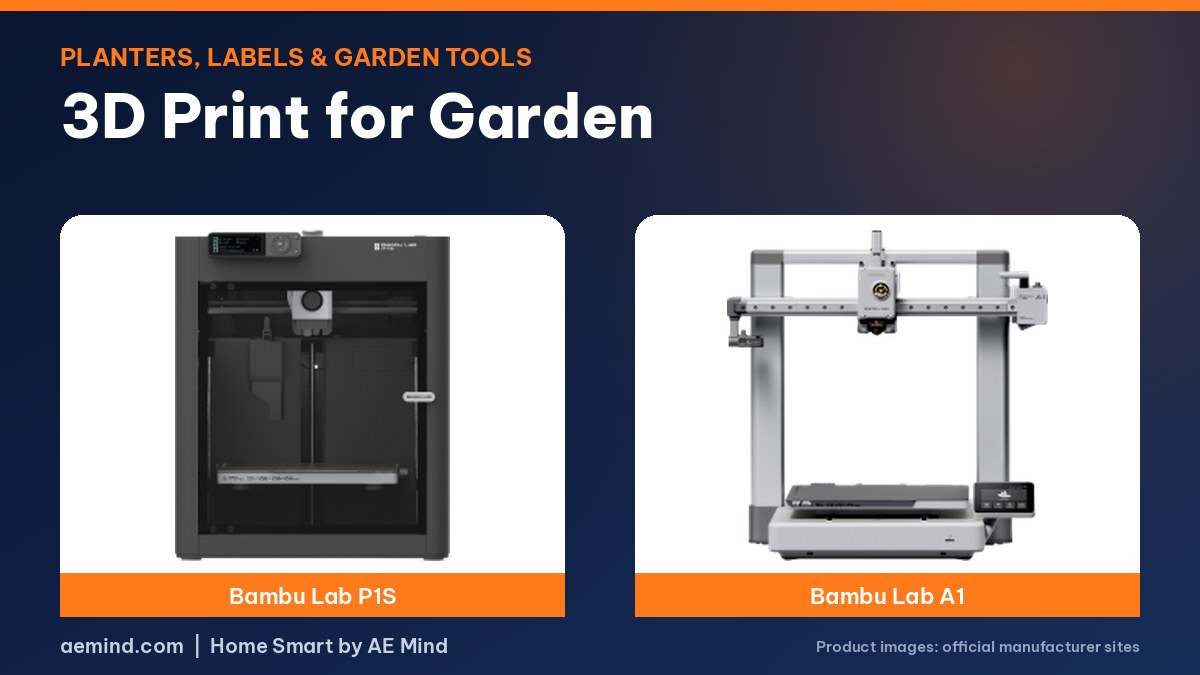
| Bambu Lab P1S Combo | $549.00 | Enclosed for UV-resistant ASA | Check price |
| Bambu Lab A1 | $299.99 | Fine for PETG planters; 256 mm bed fits Hoocho’s full-size propagator | Check price |
| Creality K2 Combo | $549.00 | Large 260 mm bed for big planters | Check price |
Compare the Bambu models in Bambu Lab A1 vs P1S.
Video: Prusa 3D, “Meaningful uses of 3D Printing in Gardening”. Embedded with credit.
Video: Hoocho, “MINI 3D Printable Self Watering Seedling Propagation System”.
3D Prints for Garden: Frequently Asked Questions
Can 3D printed planters hold water?
Yes, but layer lines can leak. Use PETG, extra walls or a sealant such as gloss spray paint, or use a printed planter as a cover pot.
What filament is best for outdoor garden prints?
ASA for sun and UV. PETG is a good second choice.
Will PLA break down in the garden?
PLA can soften in heat and degrade outdoors over time. Use it indoors.
Are 3D printed planters cheaper than store-bought?
Often. Practical Prints printed a planter, drip tray and wall mount for about $6 in material.
What is the most useful garden print?
Self-watering inserts and propagation trays save the most effort; hose adapters and plant labels are quick wins.
Sources
- Prusa 3D, “Meaningful uses of 3D Printing in Gardening”
- Practical Prints, “3d printing planters is AWESOME. Here’s why.”
- Hoocho, “MINI 3D Printable Self Watering Seedling Propagation System”
- Amazon product listings for the printers linked above, October 16, 2026
Related: Bambu Lab A1 vs P1S | PLA vs PETG for Beginners | Useful Things to 3D Print for Your Home | Things to 3D Print for Camping
Notes and disclosure
Note: Printer prices come from Amazon listings on October 16, 2026 and change often. Designs, costs and tips come from the credited YouTube creators; I have not printed these models myself.