
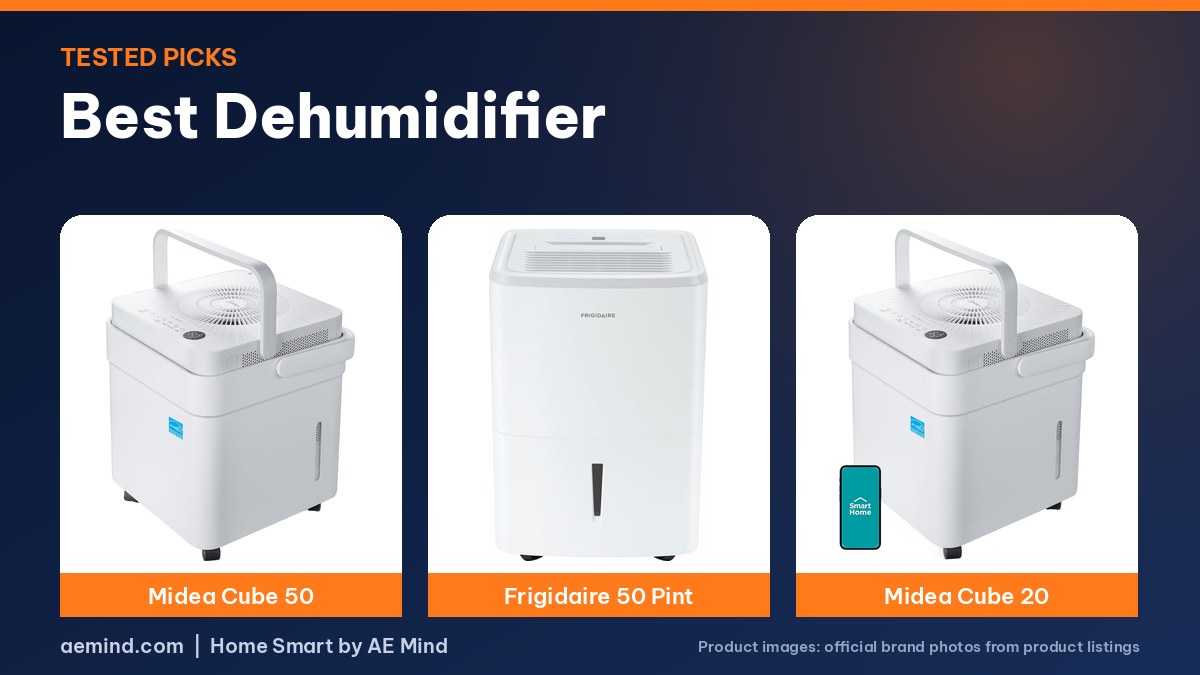
The best dehumidifier for most basements and large rooms is the Midea Cube, which dried a test room fastest, drew the least power and has by far the largest tank tested by Consumer Analysis, a YouTube channel that times how fast each model dries a sealed test room.
It is also the top pick of HouseFresh, an independent review site that bought 11 popular dehumidifiers, which measured it at 54.1 dB, quieter than the 60 to 70 dB typical of its size. Below are the picks, the test numbers, a sizing guide and Amazon prices checked October 16, 2026.
Best dehumidifier: picks at a glance
Prices checked on Amazon Oct 16, 2026. I may earn a commission from links, at no cost to you.
| Dehumidifier | Price (Amazon, Oct 16, 2026) | Why it fits | Link |
|---|---|---|---|
| Midea Cube 50 Pint | $241.59 | Fastest, most efficient and biggest tank in Consumer Analysis’ test | Check price |
| Midea Cube 20 Pint | $199.00 | Best small dehumidifier Consumer Analysis tested | Check price |
| Frigidaire 50 Pint FHDD5034Y1 | $310.62 | Second fastest; solid alternative on sale | Check price |
| hOmeLabs 50 Pint HME031003N | $269.99 | Third-highest cumulative score; runs quietly | Check price |
| Ivation 13-Pint Desiccant | $269.99 | Compact desiccant model for cold spaces | Check price |
How the testers measured dehumidifiers
Consumer Analysis raises the humidity in a 50-square-foot room to just over 90%, then times how long each machine takes to bring it down to 40%, and from 80% to 50%. It records power draw at about 50% relative humidity, measures noise from just above the unit, separating side-exhaust and top-exhaust models, and checks each built-in humidity readout against a calibrated hygrometer. HouseFresh ran its 11 units in a grow tent, logging humidity, energy use at top speed and noise from 3 feet away.
HouseFresh said performance across compressor (refrigerant) models was more consistent than it expected, with design being the main difference. It also noted that many brands share a handful of factories, and that Midea builds its own machines as well as units sold under other well-known names. That is part of why design details such as tank size, noise and drainage matter so much when choosing.
1. Midea Cube 50 Pint: best dehumidifier overall
Consumer Analysis called the Midea Cube hands-down the best dehumidifier it has tested. It took about 7.5 minutes to bring the test room from 90% to 40%, the fastest result; most models took 9 to 11 minutes. It drew 512 watts against a 567-watt average, which, combined with its speed, made it the most energy-efficient model. It was the quietest top-exhaust unit, its built-in hygrometer was among the most accurate, and its tank is the largest the channel has measured.
HouseFresh, which runs a 50-pint Cube in its basement studio, found it was not the very fastest in its grow tent but cited Energy Star’s efficiency rating of 1.9 liters per kilowatt-hour and a bucket of around 4 gallons, against 1 to 2 gallons for most rivals, so you empty it less than half as often. The Midea Cube 50 Pint listing shows a 4.2-gallon bucket. A full bucket is heavy, HouseFresh said, but you can set it to fill only halfway or a quarter, or run it continuously on a gravity hose, which sits higher on the Cube than on most models. The app needs a 2.4 GHz Wi-Fi network. The Midea Cube 35 Pint is listed as similar to a 50-pint unit under the older 2012 rating.
2. Midea Cube 20 Pint: best small dehumidifier
In Consumer Analysis’ small-unit review, the Midea Cube 20 Pint took about 13.5 minutes to dry the test room, faster than any other small dehumidifier, with very good efficiency. It was the second-quietest small model and quieter than every large one tested. Its 25.6-pint tank is bigger than most large dehumidifiers’ tanks, which average 15 to 16 pints, while most small units hold about 10. It has multiple fan speeds, a continuous mode and a target humidity range of 35% to 85%, plus a bucketless mode on a garden hose and a nesting design that tucks the body into the tank for storage. The one drawback the channel listed is a 1-year warranty, where some small rivals offer two or three years. It recommends it for spaces under about 1,000 square feet.
3. Frigidaire 50 Pint: best alternative
Consumer Analysis ranked the Frigidaire FHDD5034W1 second. It was the second-fastest at about 8.5 minutes, had average power draw but stayed highly efficient because it works so quickly, ran reasonably quietly and has the second-largest tank tested. The channel suggests it as a solid alternative when it is on sale for much less than the Cube or the Cube is out of stock. The current Amazon listing is the Frigidaire 50 Pint FHDD5034Y1, a newer version in the same series.
4. hOmeLabs 50 Pint: quiet third pick
The hOmeLabs HME1003 performed better than average in most of Consumer Analysis’ tests, runs very quietly and had the third-highest cumulative score. The matching Amazon listing is the hOmeLabs 50 Pint HME031003N, which adds Wi-Fi control and is rated for up to 7,000 square feet by the maker.
5. Ivation 13-Pint Desiccant: best for cold spaces
The Ivation 13-Pint Desiccant is about half the size of the Cube, but in HouseFresh’s test it lowered humidity nearly as fast as the big compressor units while measuring just 53.8 dB. It uses a desiccant instead of cold coils, so HouseFresh says it handles cold climates better than refrigerant models but is less efficient in warm rooms. Ivation lists 470 watts on high and 280 on low and gently warms the air, which can suit garages, crawlspaces and unheated basements. HouseFresh called it the smallest dehumidifier it would recommend, warning that tiny thermoelectric units barely beat leaving the room alone.
Dehumidifiers compared
| Midea Cube 50 Pint | Midea Cube 20 Pint | Frigidaire 50 Pint FHDD5034Y1 | hOmeLabs 50 Pint HME031003N | Ivation 13-Pint Desiccant | |
|---|---|---|---|---|---|
| Coverage | 4,500 sq ft (listed) | 1,500 sq ft (listed) | 4,500 sq ft (listed) | 7,000 sq ft (listed) | 270 sq ft (listed) |
| Tank | 4.2 gal bucket (listed) | 25.6 pints (Consumer Analysis) | Second-largest tank tested (Consumer Analysis, FHDD5034W1) | See listing | See listing |
| Notable | Consumer Analysis’ No. 1; HouseFresh’s top pick | Best small dehumidifier at Consumer Analysis | Consumer Analysis’ No. 2 (tested the W1 version) | Consumer Analysis’ No. 3; Wi-Fi (listed) | Desiccant: better in cold spaces (HouseFresh) |
| Buy | Check price | Check price | Check price | Check price | Check price |
Consumer Analysis test results
| Model | 90% to 40% time | Notes |
|---|---|---|
| Midea Cube 50 pint | About 7.5 min | Lowest draw: 512 W vs 567 W average |
| Frigidaire FHDD5034W1 | About 8.5 min | Second-largest tank |
| Most other large models | 9 to 11 min | — |
| Midea Cube 20 pint | About 13.5 min | Fastest small model; 25.6-pint tank |
What size dehumidifier do you need?
Sizing is the most common question in Reddit’s r/HomeImprovement threads. The classic sizing chart Energy Star published from the Association of Home Appliance Manufacturers (AHAM) recommends capacity by area and dampness. Use it as a starting point, and note those figures come from the older pint ratings, so a current 35-pint unit such as the Cube 35 lines up with an older 50-pint rating, according to Midea’s listing.
| Area | Moderately damp | Very damp | Wet | Extremely wet |
|---|---|---|---|---|
| 500 sq ft | 10 pints | 12 pints | 14 pints | 16 pints |
| 1,000 sq ft | 14 pints | 17 pints | 20 pints | 23 pints |
| 1,500 sq ft | 18 pints | 22 pints | 26 pints | 30 pints |
| 2,000 sq ft | 22 pints | 27 pints | 32 pints | 37 pints |
| 2,500 sq ft | 26 pints | 32 pints | 38 pints | 44 pints |
HouseFresh’s advice is to go as big as you can handle: larger units pull humidity down faster and so can use less energy overall. Energy Star defines moderately damp as a space that feels damp and smells musty only in humid weather, very damp as always damp with damp spots on walls or floor, wet as walls or floor that sweat or show seepage, and extremely wet as high-load conditions such as laundry drying or wet floors. It also notes that frost can form on the coils of compressor models below about 65°F, so for cold basements look for a unit rated for low temperatures or a desiccant model.
Buying tips from the testers
- Plan for drainage: almost every dehumidifier has a rear outlet for a garden hose, Consumer Analysis says. HouseFresh prefers gravity drain hoses to built-in pumps and suggests a separate pump if you need to lift water to a sink.
- Target 30% to 50%: Energy Star’s recommended range. A manual set mode holds a chosen humidity level, while continuous mode runs regardless of the reading.
- Check the hygrometer: Consumer Analysis found built-in humidity readings vary in accuracy; the Midea, Honeywell and TCL were among the most accurate.
- Think about noise: HouseFresh measured the fastest unit in its test, a Honeywell 50-pint, at 68.6 dB, similar to a vacuum, fine for a basement but loud in a living space.
- Look at efficiency: Energy Star lists liters removed per kilowatt-hour; HouseFresh noted Honeywell’s TP Fit range at 2.01, near the top of the database.
Dehumidifier vs air conditioner vs air purifier
An air conditioner removes some moisture while cooling, but a dehumidifier is built to hold a set humidity level without chilling the room, which is why basements and crawlspaces use them. An air purifier filters particles and does not change humidity at all; see Best Air Purifier for Allergies. If your air is too dry in winter, you need the opposite machine: Best Humidifier for a Large Room.
Video: Consumer Analysis: “The Best Dehumidifier: Latest Test Results”. Embedded with credit; the findings are the creator’s own.
Video: HouseFresh: “The Best Dehumidifiers We Tested”. Embedded with credit; the findings are the creator’s own.
Frequently Asked Questions
What is the best dehumidifier in 2026?
Consumer Analysis ranks the Midea Cube first for speed, efficiency, quiet running, hygrometer accuracy and tank size, and HouseFresh also picks it.
What size dehumidifier do I need for a basement?
Use the area and dampness chart above; for a damp 1,500-square-foot basement, the classic chart suggests about 22 pints on the older rating, and HouseFresh advises going as big as you can handle.
Is a 20-pint dehumidifier big enough?
For spaces under about 1,000 square feet, Consumer Analysis recommends the 20-pint Midea Cube.
What humidity should I set a dehumidifier to?
Energy Star calls 30% to 50% the optimum range, and 30% to 40% in cold climates during heating season to prevent window condensation; the Cube 20 lets you set between 35% and 85%.
Should I buy a dehumidifier with a pump?
HouseFresh prefers gravity drain hoses and suggests adding a separate pump if you must lift water.
Are desiccant dehumidifiers better in the cold?
Yes, HouseFresh says desiccant models like the Ivation work better in cold spaces, though they are less efficient in warm rooms.
Sources
- Amazon product listings for the products linked above, checked October 16, 2026
- Energy Star: dehumidifiers
- Energy Star: Dehumidifier Basics sizing chart (AHAM, archived)
- r/HomeImprovement: dehumidifier sizing discussion
- Consumer Analysis: “The Best Dehumidifier: Latest Test Results”
- Consumer Analysis: “The Best Small Dehumidifier We’ve Tested: Midea MAD20S1QWT Review”
- HouseFresh: “The Best Dehumidifiers We Tested”
Related: Best Humidifier for a Large Room | Evaporative vs Ultrasonic Humidifier | Best Space Heater for a Large Room | Best Air Purifier for Allergies | Portable Air Conditioner Running Cost
Notes and disclosure
Note: Prices come from Amazon listings checked on October 16, 2026. Prices change often, so check the current listing. Pint ratings, coverage and tank sizes are the manufacturers’ listed figures unless a reviewer is credited. Reviewer timings come from their own test rooms and conditions, so your results will vary with temperature, room size and how damp the space is. Pint ratings changed under the 2019 U.S. Department of Energy test, so older and newer ratings are not directly comparable. Test results and tips quoted above come from the YouTube creators credited in each section; they are their findings, not hands-on claims from me.