
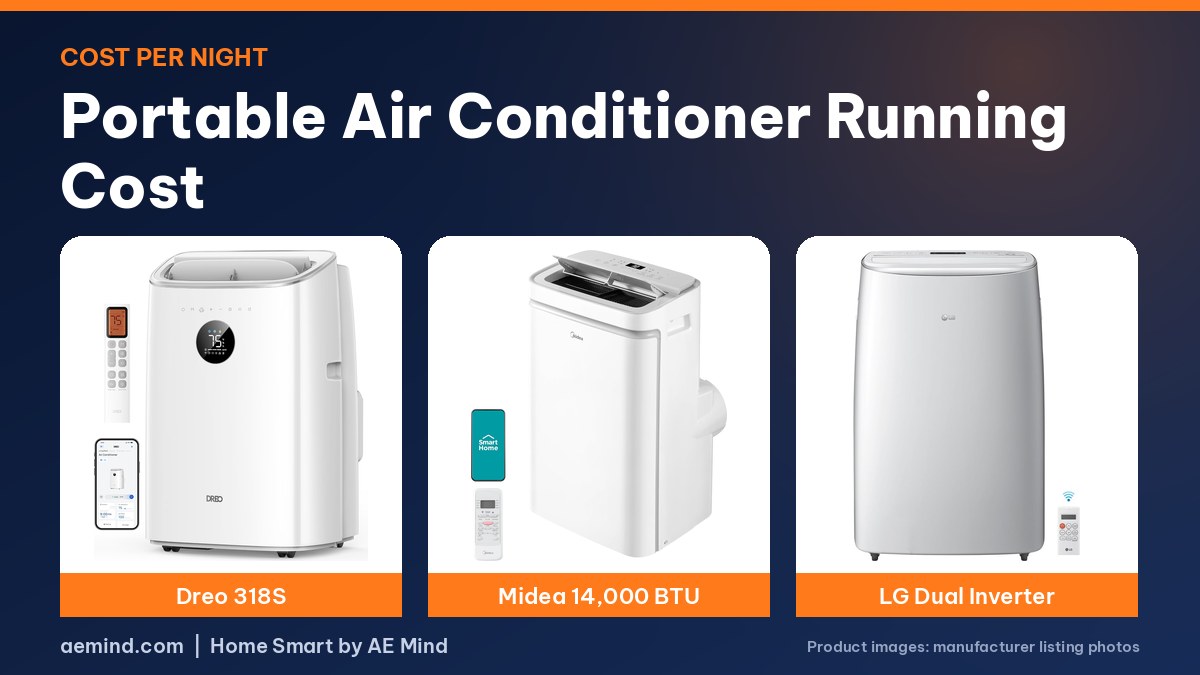
Running a portable air conditioner for an eight-hour night costs between $1.52 and $2.20 for the six models below, if each runs at its full listed wattage. That’s at the July 2026 U.S. average residential rate of 18.31 cents per kWh from the U.S. Energy Information Administration.
Real bills are usually lower because the compressor cycles off once the room is cool. The type of unit matters too. Engineering YouTube channel Technology Connections measured a 5,000 BTU window unit at 455 W, while a 5,500 BTU LG portable used “over a kilowatt.” Prices were checked on Amazon on Oct 17, 2026.
Portable Air Conditioner Running Cost by Model
Prices from Amazon at time of writing. I may earn a commission from links, at no cost to you.
| Portable AC | Price | Listed watts | Per hour | 8 hours | Per night | 30 nights |
|---|---|---|---|---|---|---|
| Dreo 318S (8,000 BTU ASHRAE) | $389.98 | 1,040 W | $0.19 | 8.3 kWh | $1.52 | $46 |
| BLACK+DECKER BPACT10WT | $319.99 | 1,220 W | $0.22 | 9.8 kWh | $1.79 | $54 |
| Whynter ARC-147WF (dual hose) | $459.99 | 1,341 W | $0.25 | 10.7 kWh | $1.96 | $59 |
| Midea 14,000 BTU | $369.99 | 1,365 W | $0.25 | 10.9 kWh | $2.00 | $60 |
| LG 10,000 BTU Dual Inverter | $590.99 | 1,370 W | $0.25 | 11.0 kWh | $2.01 | $60 |
| Dreo 515S (12,000 BTU ASHRAE) | $449.99 | 1,500 W | $0.27 | 12.0 kWh | $2.20 | $66 |
Wattages are each maker’s listed figure on Amazon. Costs assume full draw for the whole period.
How to Work Out Your Own Running Cost
- Find the wattage on the listing or the unit’s label.
- Multiply by the hours you run it and divide by 1,000 to get kWh.
- Multiply the kWh by the rate on your power bill.
Example: 1,365 W × 8 hours = 10.9 kWh. At $0.1831 per kWh, that’s about $2.00.
How Your Electricity Rate Changes the Bill
Rates vary widely by state, so here is the same 8-hour night at three example rates. These are worked examples, not quotes.
| Model (8 hours, full draw) | 12 cents/kWh | 18.31 cents/kWh (U.S. avg.) | 30 cents/kWh |
|---|---|---|---|
| Dreo 318S (8,000 BTU ASHRAE) | $1.00 | $1.52 | $2.50 |
| Midea 14,000 BTU | $1.31 | $2.00 | $3.28 |
| Dreo 515S (12,000 BTU ASHRAE) | $1.44 | $2.20 | $3.60 |
What a Full Summer Could Cost
As a worked example, running 8 hours a night for the 92 days of June, July and August at full listed wattage would cost about $140 for the Dreo 318S, $184 for the Midea and $202 for the Dreo 515S at 18.31 cents per kWh. That’s an upper bound for these hours, since compressor cycling lowers real use. A smaller unit costs less to run, but only if it can actually cool your room. Check the SACC rating and the listed room size before choosing on wattage alone.
Why Real Use Is Usually Lower
A compressor doesn’t draw full power all night once it reaches the set temperature. Inverter models go further. Silver Cymbal, a YouTube reviewer who has used an inverter Midea Duo for two years, said it “will use a lot less once the space is cooled because the inverter can simply ramp down the compressor.” He added that at 14,000 BTU it still “does use a significant amount of energy if it’s always running on high” (Silver Cymbal, “Is the Midea DUO Smart Inverter Portable Air Conditioner Worth It?”; Midea provided his unit at no charge).
Portable vs Window Unit Power Use
LDSreliance logged a single-duct portable and a window unit at maximum cool for three days above 100°F. Dividing kWh by each unit’s BTU rating, the two were “almost identical.” He cautioned that he couldn’t measure cooling output, and that single-duct units waste cooled air and pull hot air in through negative pressure (LDSreliance, “Energy Consumption Tested & Compared – Window vs Portable Air Conditioners”).
Technology Connections recommends a window unit if you can install one, because its hot side sits outside (Technology Connections, “Portable Air Conditioners – Why you shouldn’t like them”).
Ways to Lower the Cost
- Compare SACC ratings: they account for hose losses, so you can size the unit to the room.
- Use dual hose for long run times: the Whynter ARC-147WF lists 1,341 W for 14,000 BTU dual-hose cooling. See our dual vs single hose explainer.
- Consider an inverter: the LG Dual Inverter lists an inverter compressor and a 44 dB sleep mode.
- Let the thermostat work: per Silver Cymbal, running on high all the time uses the most energy.
- Seal the window kit and close doors and blinds.
Video: LDSreliance, “Energy Consumption Tested & Compared – Window vs Portable Air Conditioners”. Embedded with credit; the findings are the creator’s own.
Frequently Asked Questions
How much does it cost to run a portable AC all night?
About $1.52 to $2.20 for 8 hours at full listed wattage for these models, at the U.S. average rate.
How much does a portable AC cost per hour?
From about 19 cents (1,040 W) to 27 cents (1,500 W) per hour at 18.31 cents per kWh.
Do portable ACs use a lot of electricity?
These models list 1,040 W to 1,500 W. Technology Connections found a portable used over twice the power of a similar-capacity window unit.
Is an inverter portable AC cheaper to run?
It can be, since an inverter ramps down once the room is cool, Silver Cymbal says. On high, it still uses a lot.
Sources
- U.S. EIA, Electric Power Monthly, Table 5.6.A (July 2026 average residential price)
- Technology Connections, “Portable Air Conditioners – Why you shouldn’t like them”
- LDSreliance, “Energy Consumption Tested & Compared – Window vs Portable Air Conditioners”
- Silver Cymbal, “Is the Midea DUO Smart Inverter Portable Air Conditioner Worth It?”
- Amazon listings for each linked model, from Amazon at time of writing
Related: Dreo Portable AC Review | Portable AC for Renters | Dual Hose vs Single Hose | Portable AC Without a Window
Notes and disclosure
Note: Prices come from Amazon listings at time of writing. Ratings, wattage, weight and noise are the manufacturers’ listed numbers unless a reviewer is credited. Running costs are worked examples at the July 2026 U.S. average residential rate of 18.31 cents per kWh (EIA), so use the rate on your own bill. Findings come from the YouTube creators credited above, not hands-on claims from me.