
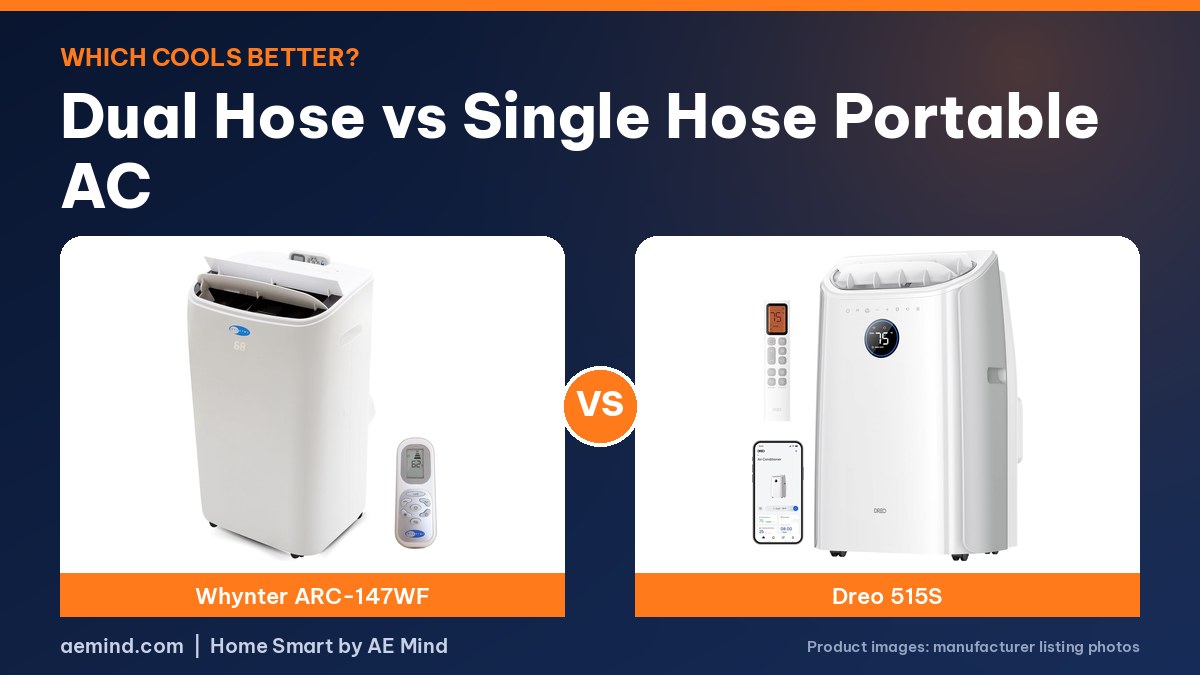
A single-hose portable air conditioner is “basically 25% less efficient” than its basic BTU rating suggests, according to engineering YouTube channel Technology Connections. The reason is that it exhausts room air it has already cooled. A dual-hose unit avoids most of that loss by cooling its condenser with outside air.
One home test complicates the picture. LDSreliance ran a single-duct portable and a window unit side by side for three days above 100°F, and found their energy use per rated BTU “almost identical.” He couldn’t measure actual cooling output, though. Here’s how the physics works, what the tests show, and when each hose type makes sense, with Amazon prices from Amazon at time of writing.
Dual Hose vs Single Hose Portable Air Conditioner: Models Compared
Prices from Amazon at time of writing. I may earn a commission from links, at no cost to you.
| Spec | Whynter ARC-147WF | Midea 14,000 BTU | Dreo 318S | BLACK+DECKER BPACT10WT |
|---|---|---|---|---|
| Hose type | Dual hose | Single hose | Single hose | Single hose |
| Price | $459.99 | $369.99 | $389.98 | $319.99 |
| Rating | 14,000 BTU | 14,000 ASHRAE / 10,000 SACC | 8,000 ASHRAE / 5,000 SACC | 10,000 ASHRAE / 5,550 DOE |
| Listed room size | 500 sq ft | 450 sq ft | — | 450 sq ft |
| Listed wattage | 1,341 W | 1,365 W | 1,040 W | 1,220 W |
| Listed noise | 51 dB | 51.5 dB | 45 dB | 54 dB |
| Draining | Auto drain | See listing | Drain-free below 90% humidity | Drain hose included |
| Weight | 77 lb | 69.7 lb | 55 lb | 47.3 lb |
All figures are the manufacturers’ listed numbers on Amazon.
How a Single-Hose Unit Loses Cooling
Every air conditioner has a cold side (the evaporator) and a hot side (the condenser). In a window unit, Technology Connections explains, the hot side sits outside, and “only a tiny hole is required in the home’s thermal barrier.” A portable keeps both sides in the room.
A single-hose portable sucks in indoor air through its vents, blows it across the condenser and pushes it outside through the hose. That sacrifices air it just cooled, and it makes the air pressure outside the room greater than inside, so warm air leaks back in around doors and windows. Newer testing methods account for this, which is why a unit that can technically move 8,000 BTU per hour carries a lower seasonally adjusted rating (Technology Connections, “Portable Air Conditioners – Why you shouldn’t like them”).
Reading the Two Ratings
The ASHRAE number is the big one on the box. The SACC (or DOE) number includes hose losses. In the table above, the Midea drops from 14,000 to 10,000 and the Dreo 318S from 8,000 to 5,000. Compare SACC to SACC.
How a Dual-Hose Unit Fixes It
Dual-hose portables “suck in outside air to cool the condenser and then blow it back out” through a second hose, so they don’t pull cooled room air outside, Technology Connections said. He also noted they’re “an increasingly rare part” of the market (Technology Connections, “Portable Air Conditioners – Why you shouldn’t like them”).
Silver Cymbal has used a 14,000 BTU dual-hose Midea Duo for two years in a loft of about 800 sq ft with very high ceilings, which he called “a bit of a stretch for this model.” He said a true dual-hose unit gives “the most efficiency and of course the fastest cooling,” and called it the best option for a really hot space like an attic (Silver Cymbal, “Is the Midea DUO Smart Inverter Portable Air Conditioner Worth It?”; Midea provided his unit at no charge).
What the Energy Test Showed
LDSreliance logged kilowatt-hours on a single-duct portable and a window unit, running both at maximum cool on three of the hottest days of the year. Dividing energy by each unit’s BTU rating, the two were “almost identical,” which he said shocked him. He cautioned that this is “only half the story,” since he had no way to measure cooling output, and single-duct units still pull hot air in through negative pressure (LDSreliance, “Energy Consumption Tested & Compared – Window vs Portable Air Conditioners”).
Technology Connections’ own comparison found a 5,000 BTU window unit drew 455 W, while a 5,500 BTU LG portable used “over a kilowatt” (Technology Connections, “Portable Air Conditioners – Why you shouldn’t like them”).
When Dual Hose Is Worth It
- Hot rooms: attics, lofts and sun-facing rooms, where Silver Cymbal says dual hose gives the best overall performance.
- Long daily run times: less cooled air goes out the window.
- Pick: the Whynter ARC-147WF ($459.99) lists 14,000 BTU dual-hose cooling for up to 500 sq ft, auto drain, 51 dB and a HEPA and activated carbon filter.
When Single Hose Is Fine
- Small rooms used a few hours at a time: setup is simpler with one hose.
- Quiet bedrooms: the Dreo 318S lists 45 dB, 1,040 W and drain-free operation.
- Budget: the BLACK+DECKER BPACT10WT costs $319.99.
- Seal it well: close the door, and seal the window kit. Silver Cymbal suggested weather stripping for a fuller seal.
Video: Technology Connections, “Portable Air Conditioners – Why you shouldn’t like them”. Embedded with credit; the findings are the creator’s own.
Frequently Asked Questions
Is a dual-hose portable AC better than single hose?
For efficiency and cooling speed, yes, according to Technology Connections and Silver Cymbal.
Do single-hose units really use more power?
In LDSreliance’s three-day test, energy per rated BTU was almost identical to a window unit, but real cooling output wasn’t measured.
What is SACC?
A seasonally adjusted rating that accounts for hose losses. It’s lower than the ASHRAE number and better for comparing portables.
Is a window unit better still?
Technology Connections recommends a window unit if you can use one, because its hot side is outside.
Sources
- Technology Connections, “Portable Air Conditioners – Why you shouldn’t like them”
- LDSreliance, “Energy Consumption Tested & Compared – Window vs Portable Air Conditioners”
- Silver Cymbal, “Is the Midea DUO Smart Inverter Portable Air Conditioner Worth It?”
- Amazon listings for each linked model, from Amazon at time of writing
Related: Portable AC for Renters | Dreo Portable AC Review | Running Cost | Portable AC Without a Window
Notes and disclosure
Note: Prices come from Amazon listings at time of writing. Ratings, wattage, weight and noise are listed manufacturer figures. Findings come from the YouTube creators credited above, not hands-on claims from me.