
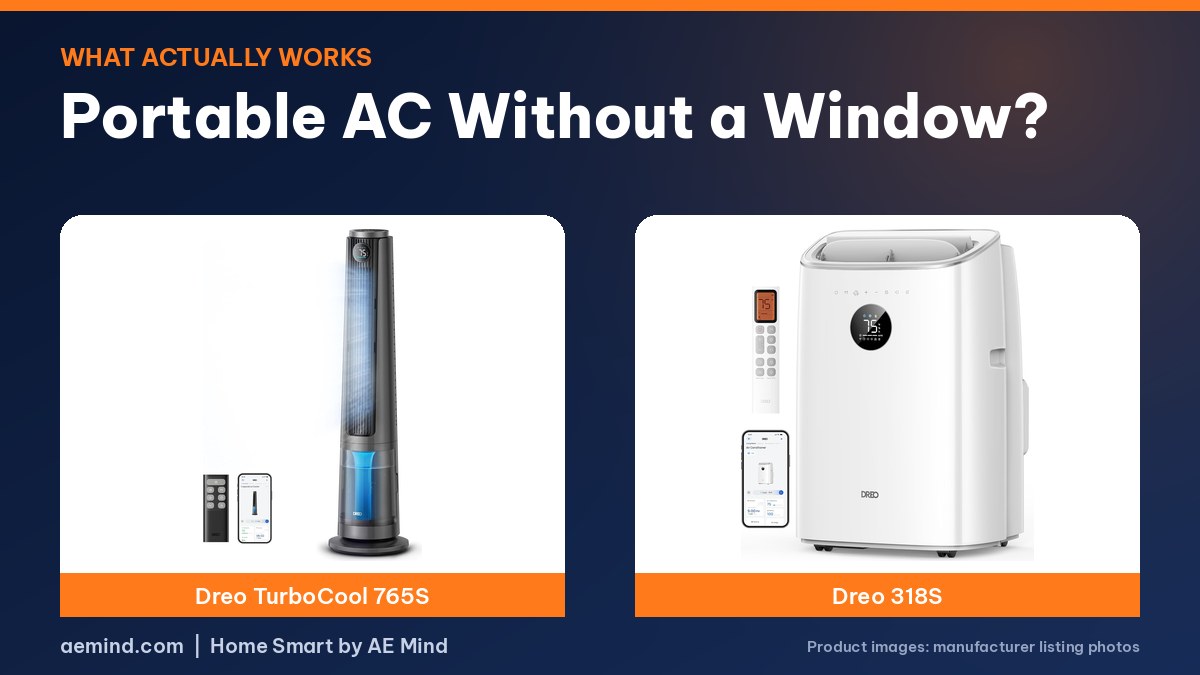
A portable air conditioner can’t cool a room without venting somewhere. Every AC has to move the heat it removes outside, explains engineering YouTube channel Technology Connections. If you truly can’t vent a hose, the realistic alternative is an evaporative misting fan, which cools you by evaporation instead.
Paul Hibbert, a smart-home YouTuber with installed air conditioning at home, tested Dreo’s TurboCool misting fan on a 33°C (about 91°F) day. He said it kept him “at a very, very cold temperature” when he pointed it at himself. Below are the options by venting situation, with Amazon prices at time of writing.
Portable Air Conditioner Without a Window: Options Compared
Prices from Amazon at time of writing. I may earn a commission from links, at no cost to you.
| Your situation | Option | Price (Amazon, Oct 17, 2026) | How it cools |
|---|---|---|---|
| No vent at all | Dreo TurboCool Misting Fan 765S | $199.99 | 17-micron mist evaporates; Dreo lists up to 10°F cooler |
| Sliding window or door | Dreo 318S (8,000 BTU ASHRAE / 5,000 SACC) | $389.98 | Refrigerant AC, vents through the included window kit |
| Can vent two hoses | Whynter ARC-147WF (14,000 BTU dual hose) | $459.99 | Refrigerant AC; dual hose for better efficiency |
Why a Real AC Needs a Vent
Air conditioners move heat from one place to another, Technology Connections explains. A window unit keeps its hot side outside. A portable keeps the whole machine indoors, so its hose has to carry that heat out. A single-hose unit blows indoor air across its condenser and out the hose, which also sacrifices some of the cool air it just made (Technology Connections, “Portable Air Conditioners – Why you shouldn’t like them”). Without a vent, the heat stays in the room.
Venting Options That Aren’t a Standard Window
- Sliding windows and doors: window kits such as Dreo’s are made for these.
- Awkward windows: Technology Connections uses a portable precisely because his window can’t safely hold a window unit.
- Two openings: a dual-hose unit like the Whynter needs room for both hoses.
- Renting: check your lease before cutting into walls, doors or ceilings.
How a Misting Fan Works
Air conditioning “uses refrigeration to physically remove heat from a room and dump it outside,” Paul Hibbert explained. A misting fan instead uses “tiny 17 micron water droplets to absorb heat from the surrounding air as they evaporate” (Paul Hibbert, “Aircon Without Installing Aircon | DREO TurboCool”; Dreo sponsored the video).
| Dreo 765S listed spec | Figure |
|---|---|
| Mist | 17 μm ultrasonic mist; up to 10°F temperature drop |
| Airflow | 34 ft/s, reaching up to 59.7 ft |
| Noise | As low as 20 dB |
| Tank | 6 L; up to 7 hours turbo mist or 30 hours on low |
| Modes | Fan, misting cooler, humidifier; 12 speeds, 4 modes |
| Controls | App, voice and remote; built-in temperature and humidity sensor |
What Paul Hibbert’s Test Found
- Conditions: 26°C outside before 10 a.m., heading to 33°C. He called it the hottest day of the year, with record temperatures where he lives.
- Personal cooling: pointing it straight at himself cooled him down. Turbo mode felt colder even though the fan seemed slower.
- Humidity: after 2 hours 20 minutes in a small room with little ventilation, his nose was stuffy and the room got “pretty muggy.” Cracking a window let moisture out, which he said matters for cooling and comfort.
- Tank life: about 8 to 9 hours of mostly turbo use left roughly half the tank, “more than Dreo actually advertised.”
- Smart features: the app found the fan immediately. It offers child lock, target humidity and oscillation angle, and he set an Alexa routine for full mist, turbo mode and oscillation.
He compared it with his wall-mounted AC, which he said cost about £2,000 to install and cools a room faster without adding moisture. For the price of putting up with some moisture you can vent through a window, he said he “probably would have got this and not spent the money” (Paul Hibbert, “Aircon Without Installing Aircon | DREO TurboCool”).
Misting Fan vs Portable AC at a Glance
| Dreo TurboCool 765S misting fan | Dreo 318S portable AC | |
|---|---|---|
| Needs a vent | No | Yes, through a window kit |
| How it cools | Evaporation of fine mist | Refrigerant cycle, heat sent outside |
| Effect on humidity | Adds moisture | Has a Dry mode; drain-free below 90% humidity |
| Water | Refill the 6 L tank | No refill needed |
| Price | $199.99 | $389.98 |
All figures are Dreo’s listed specs on Amazon. A misting fan is best for cooling the people in front of it; an AC lowers the temperature of the whole room.
Which to Buy
- No vent at all: Dreo TurboCool 765S ($199.99). Expect personal cooling plus added humidity, and crack a window when you can.
- A sliding window: Dreo 318S ($389.98) lists 1,040 W and drain-free operation below 90% humidity. See our Dreo review.
- Room for two hoses: Whynter ARC-147WF ($459.99) lists up to 500 sq ft and auto drain. See dual vs single hose.
Video: Paul Hibbert, “Aircon Without Installing Aircon | DREO TurboCool”. Embedded with credit; the findings are the creator’s own.
Frequently Asked Questions
Can you use a portable AC without venting it?
Not effectively. The heat it removes has to go outside, according to Technology Connections.
What cools a room with no window?
An evaporative misting fan like the Dreo TurboCool cools by evaporation. Paul Hibbert recommends some ventilation so humidity doesn’t build up.
Does a misting fan make a room humid?
Yes, it adds moisture. Paul Hibbert’s small room got muggy until he cracked a window.
Is a misting fan an air conditioner?
No. It’s an evaporative cooler, fan and humidifier, not a refrigerant AC.
Sources
- Paul Hibbert, “Aircon Without Installing Aircon | DREO TurboCool”
- Technology Connections, “Portable Air Conditioners – Why you shouldn’t like them”
- Amazon listings for the Dreo 765S, Dreo 318S and Whynter ARC-147WF
Related: Dreo Portable AC Review | Portable AC for Renters | Dual Hose vs Single Hose | Running Cost
Notes and disclosure
Note: Prices come from Amazon listings at time of writing. Specs are the manufacturers’ listed numbers unless a reviewer is credited. Findings come from the YouTube creators credited above, not hands-on claims from me.