
A 3D printed part that uses $4.90 of filament sells for $55 at Print Farm Academy, a YouTube channel run by a print-farm owner. He says filament cost is “not a very good indicator” of what a part really costs, and prices from the full landed cost instead: material, hardware, packaging, labor and machine time.
Pricing below that cost means “you’re running a charity, not a business,” he said. A second seller, I Love 3D Printing, ran the same kind of math on a real Etsy item and found the right price was about $14.99, not the roughly $10 he said he had seen others charge.
Below is the cost formula, worked examples from both creators, and how to turn a landed cost into a selling price.
Important: Prices and costs below are the creators’ own figures from their videos. Your filament, labor rate, fees and power costs will differ.
How to Price 3D Prints: The Formula
Prices from Amazon at time of writing. I may earn a commission from links, at no cost to you.
| Cost component | How to figure it (Print Farm Academy) |
|---|---|
| Raw material | Total grams used, including purge towers, from your slicer × 1.1 efficiency factor × cost per gram |
| Purchased materials | Heat-set inserts, screws, magnets and any other third-party parts |
| Packaging and shipping | Box or mailer, tape, padding, packing slip, label, plus average postage if you offer free shipping |
| Labor | Minutes to start, remove, clean, post-process and pack × an hourly rate ($20/hour suggested as a starting point) |
| Machine cost | Printer price plus repairs ÷ lifetime print hours, plus electricity, × 1.3 buffer |
| Selling fees | Etsy charges a 6.5% transaction fee plus payment processing and listing fees (Etsy fee policy) |
Add the first five lines to get the landed cost, then set a margin and check it against the market (Print Farm Academy, “Why I charge $55 for this 3D printed part (how to price)”).
The Cost Most Sellers Leave Out: Machine Time
Print Farm Academy says machine cost is the component he sees most people skip. His method: assume a $1,000 printer lasts about three years in a busy farm, running about half the hours in a year (4,380 hours a year, or 13,140 in total). Add 5% to 10% of its price per year in repairs, which he rounds to $250 over its life (Print Farm Academy, “Why I charge $55 for this 3D printed part (how to price)”).
That works out to roughly 9.5 cents an hour for the machine. Add electricity, about 2 cents an hour for a 150 W printer at 14 cents per kWh, and multiply by a 1.3 buffer for about 15 cents an hour. Across many printers and hours, he said, leaving it out could mean up to $180 a day of unaccounted cost in his farm.
Machine cost per hour for popular printers
Below, Print Farm Academy’s assumptions (three-year life, 13,140 print hours, 25% of price in repairs, 150 W at $0.14/kWh, 1.3 buffer) are applied to Amazon prices from Oct 17, 2026. These are estimates from his formula, not measured costs. Real wattage varies by printer and material.
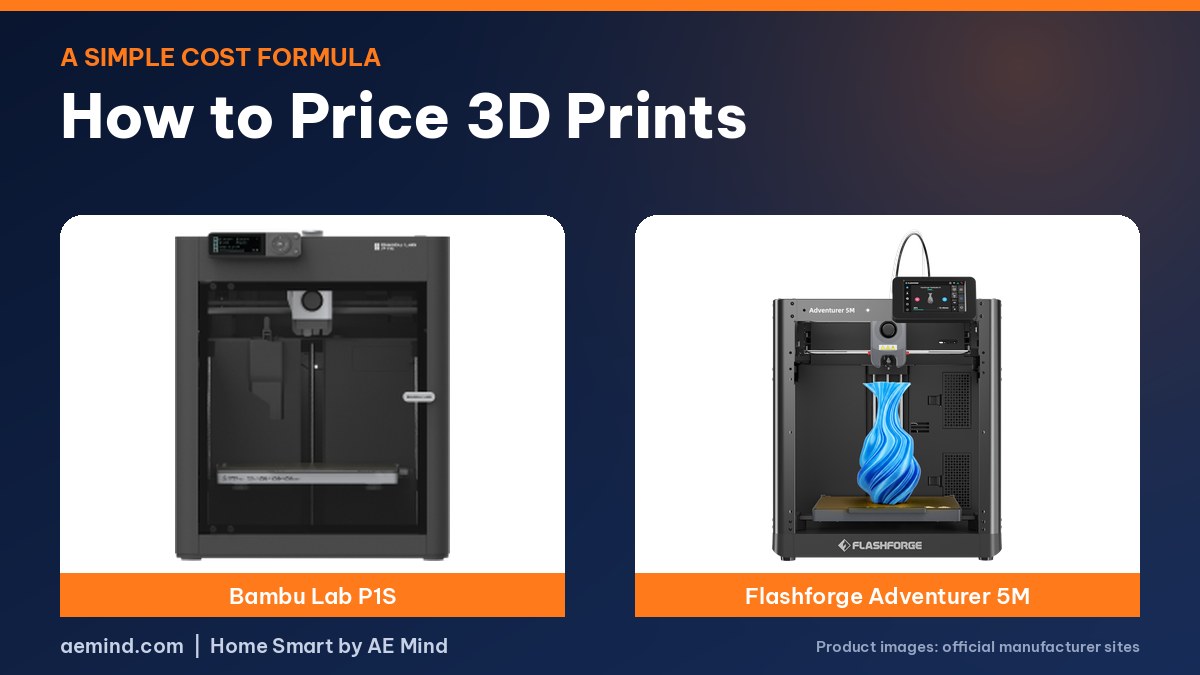
| Printer | Price | Est. machine + power cost per hour | Buy |
|---|---|---|---|
| Flashforge Adventurer 5M | $249.00 | About 5.8 cents | Check price |
| Bambu Lab A1 | $299.99 | About 6.4 cents | Check price |
| Bambu Lab P1S Combo | $549.00 | About 9.5 cents | Check price |
| $1,000 printer (his example) | — | About 15 cents | — |
Worked Examples From the Creators
Print Farm Academy: battery hangers
A six-pack of DeWalt battery hangers used 163 g of filament, or 179 g after the 1.1 factor. At $33 a kilogram, that is $5.98 of material. Add $5.76 of packaging and shipping, 2 minutes of labor at $30 an hour ($1) and 5.1 hours of print time (77 cents of machine cost), and the landed cost comes to about $13.50. He said he could sell them for $27, or $33.75 for a higher margin (Print Farm Academy, “Why I charge $55 for this 3D printed part (how to price)”).
Print Farm Academy: a stop-block jig with hardware
A miter-saw stop block needs six heat-set inserts, four screws, an aluminum plate and other hardware. Material was about $2.38, but the purchased parts added $5.63, and 12 minutes of labor added $6, for a landed cost of about $20.07. He’d charge at least $40. Parts that are hard to make, with lots of post-processing or third-party hardware, can carry higher margins, he said, which is why his $55 part works (Print Farm Academy, “Why I charge $55 for this 3D printed part (how to price)”).
I Love 3D Printing: an Etsy item
His item used 160 g of $20-a-kilogram filament, about 2 cents a gram. He added print-time electricity and printer wear at about 10 cents an hour, his time at $10 an hour and $1 of packaging, then rounded up for Etsy fees and profit to about $14.99. He suggested adding about a 50% margin on top of cost to stay profitable (I Love 3D Printing, “How I Price My 3D Prints – Full Cost Breakdown + Profit Margin”).
Turning Landed Cost Into a Price
- Margin method. Multiply landed cost by your target margin factor. Print Farm Academy calls this “a great gut check.” A 50% margin put his reveal spacers at about $20 (Print Farm Academy, “Why I charge $55 for this 3D printed part (how to price)”).
- Market check. If similar products sell well below your number, he says you can either position yours as superior and charge more, or reduce your margin to compete.
- Work back from the market. One seller on r/3DprintEntrepreneurs said they start from the highest realistic market price. Another said Etsy fees come to about 10% to 11% once transaction and payment processing fees are combined.
- Don’t race to the bottom. I Love 3D Printing said pricing below everyone else can create distrust and forces you to sell much more (I Love 3D Printing, “How I Price My 3D Prints – Full Cost Breakdown + Profit Margin”).
Common Pricing Mistakes
- Counting only filament (both creators)
- Using the part weight but not the purge tower or waste (Print Farm Academy)
- Setting labor at zero because you do the work yourself. Print Farm Academy says your time is worth something, and help costs money if you scale.
- Leaving out machine cost and electricity
- Forgetting Etsy fees, which change, so check Etsy’s current fee page
How This Guide Was Researched
Formulas and examples come from the two YouTube creators credited above and a Reddit seller thread. Etsy fees come from Etsy’s fee policy. Printer prices come from Amazon on Oct 17, 2026. Per-hour machine costs are my arithmetic using Print Farm Academy’s stated assumptions.
Video: Print Farm Academy, “Why I charge $55 for this 3D printed part (how to price)”
Frequently Asked Questions
How much should I charge per hour of 3D printing?
There is no standard rate. Print Farm Academy charges machine time at about 15 cents an hour for a $1,000 printer under his assumptions, then adds labor, materials, packaging and margin on top.
Should I charge by the gram?
Not by itself. In Print Farm Academy’s examples, packaging and labor often cost more than the filament.
What profit margin should I use?
Both creators use about 50% as a starting point, then adjust to the market and to how hard the part is to make.
How much does Etsy take?
Etsy charges a 6.5% transaction fee plus payment processing and listing fees. A Reddit seller estimated about 10% to 11% combined. Check Etsy’s current fee page.
Is there a 3D print price calculator?
Print Farm Academy offers a free cost worksheet, and I Love 3D Printing showed a calculator that takes filament, time, hourly rate and power cost.
Sources
- Print Farm Academy, “Why I charge $55 for this 3D printed part (how to price)”
- I Love 3D Printing, “How I Price My 3D Prints – Full Cost Breakdown + Profit Margin”
- r/3DprintEntrepreneurs: Etsy pricing workflow thread
- Etsy Fees & Payments Policy
- Amazon listings: Flashforge Adventurer 5M, Bambu Lab A1, Bambu Lab P1S Combo (from Amazon at time of writing)
Related: Is a 3D Printing Business Profitable? | Best Things to 3D Print and Sell | How to Start a 3D Printing Etsy Shop
Notes and disclosure
Note: Printer prices come from Amazon listings at time of writing. Cost figures are the creators’ own examples. Per-hour machine estimates apply Print Farm Academy’s assumptions and are not measurements.