
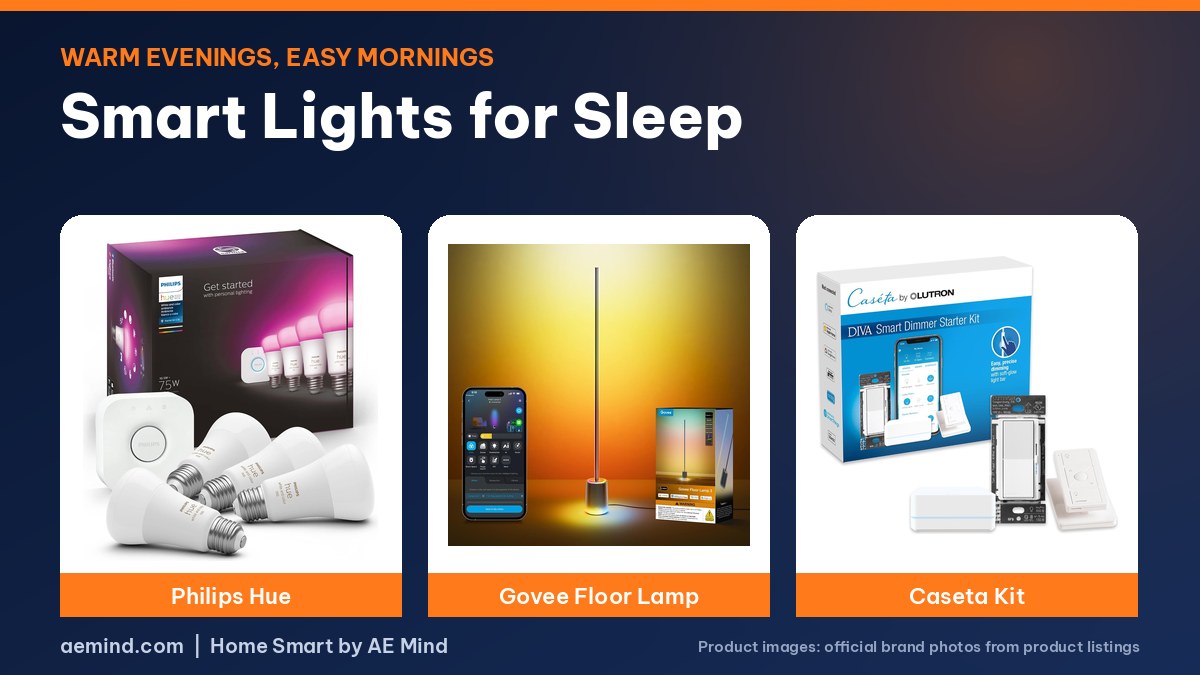
Smart lights for sleep work by getting warmer and dimmer as the night goes on, because bright, daylight-colored light at night suppresses melatonin, according to Josh Teder of 6 Months Later, a smart home review channel that walks through the bedtime automations it runs at home (6 Months Later, “How to Sleep Better by using SMART LIGHTS”). His bedroom lights fade into a sunset that slowly goes dark over 45 minutes, and a sunrise scene fades in each morning.
You need lights that can shift from cool daylight to warm white. Teder recommends full-color bulbs in bedrooms and cheaper tunable-white bulbs elsewhere, then a handful of scenes on a schedule. Automate Your Life, a smart home channel, ranks Lutron then Hue highest for reliability, which matters for lights you rely on every night (Automate Your Life, “Philips Hue vs Govee vs Ikea vs Lutron – Which is The Best Smart Lighting?”).
Smart Lights for Sleep: Quick Picks
Prices from Amazon at time of writing. I may earn a commission from links, at no cost to you.
| Light | Price (Amazon, Oct 16, 2026) | Why it fits | Link |
|---|---|---|---|
| Philips Hue Starter Kit (Bridge + 4 color A19 bulbs) | $136.47 | Natural Light, Time-Based Light and fade automations built into the Hue app, per 6 Months Later | Check price |
| Govee Floor Lamp 3 | $149.99 | Tunable 1000K–10000K with a DaySync circadian mode and a dim base glow for night (listed) | Check price |
| Lutron Caseta Diva Smart Dimmer Starter Kit | $125.08 | Dim ordinary bulbs from a wall dimmer or bedside Pico remote; no smart bulbs needed | Check price |
Why Warm, Dim Light at Night
Teder explains that melatonin is a hormone the brain produces in response to darkness that helps you fall asleep on time; a lot of light at night, or daylight-colored light, suppresses it (6 Months Later, “How to Sleep Better by using SMART LIGHTS”). In the channel’s subscriber poll, 22% of respondents picked the wrong bulb color for a bedroom. His advice is to switch to a warmer color temperature at night and keep dimming as the night goes on, not just warm the light. He also suggests keeping phones out of the bedroom.
How to Set Up Smart Lights for Sleep
1. Build scenes for each part of the day
A scene saves the color temperature and brightness of every bulb in a room. Teder recommends five per room: morning, workday, early evening, late evening and bedtime (6 Months Later, “How to Sleep Better by using SMART LIGHTS”). The Hue app offers prebuilt scenes, or you can make your own from a photo or color picker.
2. Or let Natural Light do it
Hue’s Natural Light scene sets color temperature and brightness automatically based on local time (6 Months Later, “How to Sleep Better by using SMART LIGHTS”). Teder’s caveat: in rooms with many bright bulbs it can run too bright, so use custom scenes there. Custom scenes also let you add more colorful sunrise and sunset looks.
3. Tie scenes to switches and sensors
Hue’s Time-Based Light picks the right scene for the time when someone presses a dimmer switch or walks past a motion sensor (6 Months Later, “How to Sleep Better by using SMART LIGHTS”). His bathroom example: at night, the Hue button turns on only a very dim shower light so you aren’t blinded on a late trip. Motion sensors get separate day and night behavior and can turn lights off after a set time, which suits hallways and closets.
4. Automate the big transitions
Teder’s custom Hue automations (6 Months Later, “How to Sleep Better by using SMART LIGHTS”):
- Sunrise, 8:15 a.m.: bedroom lights fade in over 15 minutes to a “First Light” scene with dawn colors; the bathroom goes to its daytime scene.
- Work lighting, 8:30 a.m.: a daytime work scene fades in over 30 minutes.
- Afternoon shift: the workspace moves from daylight to a warmer tone, a cue that the workday is over.
- Sunset, 9:30 p.m.: a sunset scene fades in over about 30 minutes.
- Lights out, about 11:30 p.m.: the bedroom starts a 45-minute fade to black.
The built-in Wake Up and Go to Sleep automations are enough if you only want lights to fade in and out; custom automations let you fade to a specific scene. Teder says other brands can do similar things through IFTTT, Home Assistant, or Amazon, Google and Apple routines (6 Months Later, “How to Sleep Better by using SMART LIGHTS”).
Video: 6 Months Later, “How to Sleep Better by using SMART LIGHTS”. Embedded with credit.
Choosing a Smart Lighting System for Sleep
Automate Your Life compared Hue, Govee, IKEA and Lutron (Automate Your Life, “Philips Hue vs Govee vs Ikea vs Lutron – Which is The Best Smart Lighting?”):
- Philips Hue: mostly Zigbee through the Hue Bridge, with local control that keeps working if Wi-Fi or the internet drops. He has tested that since 2018. Expensive at the top end.
- Govee: best for color and effects with 800-plus preset scenes, but Wi-Fi devices can strain a router in large setups; he says a mesh system helped.
- IKEA: Matter over Thread keeps traffic off Wi-Fi and is low power, but needs a working Thread network.
- Lutron: wall dimmers and remotes he calls “lighting infrastructure,” ranked first for reliability.
He notes that connecting lights to other apps through Matter typically gives only basic controls, so features like dynamic scenes stay in each brand’s own app (Automate Your Life, “Philips Hue vs Govee vs Ikea vs Lutron – Which is The Best Smart Lighting?”).
Best Smart Lights for Sleep by Setup
- Bulbs in lamps and fixtures: the Philips Hue Starter Kit (Bridge + 4 color A19 bulbs) includes four color bulbs and a bridge for every automation above.
- One lamp that does it all: the Govee Floor Lamp 3 lists a base ring you can leave on as a dim night path while the main post stays off.
- Wall switch control: the Lutron Caseta Diva Smart Dimmer Starter Kit dims the bulbs you already own on a schedule and adds a bedside Pico remote. It doesn’t change color temperature, so pair it with warm bulbs.
Add Blackout Shades
Light from outside matters too. Smart blackout shades can stay closed until your alarm and then open, as covered in Blackout Smart Blinds for Sleep.
Smart Lights for Sleep: Frequently Asked Questions
What color light is best for sleep?
Warm, dim light at night. 6 Months Later says daylight-colored light at night suppresses melatonin.
Can smart lights help you wake up?
Yes. 6 Months Later fades bedroom lights in over 15 minutes each morning with a dawn-colored scene.
Do I need color bulbs for sleep lighting?
No. Tunable-white bulbs that shift warm are enough; 6 Months Later suggests color bulbs mainly for bedrooms.
Can I use Lutron Caseta for sleep lighting?
Yes, for dimming on a schedule. Caseta does not change color temperature, so the warmth depends on your bulbs.
How long should lights take to fade out at night?
6 Months Later uses a 45-minute fade to black at bedtime.
Sources
- 6 Months Later, “How to Sleep Better by using SMART LIGHTS”
- Automate Your Life, “Philips Hue vs Govee vs Ikea vs Lutron – Which is The Best Smart Lighting?”
- Amazon product listings for the products linked above, from Amazon at time of writing
Related: Philips Hue Starter Kit Review | Best Smart Lighting System | Blackout Smart Blinds for Sleep
Notes and disclosure
Note: Prices come from Amazon listings at time of writing. Specs are the manufacturers’ listed numbers unless a reviewer is credited. Setup steps and opinions come from the credited YouTube creators. This is general lighting guidance, not medical advice. I have not tested these products myself.