
3D printed drywall anchors can work for light items if they are printed in PETG, on their side, from a design made for printing. One such anchor held over 75 lb (34 kg) in its designer’s wall test, according to Ptarmigan, the Printables designer behind it, who adds: “I would not recommend putting anywhere near that amount of weight on a single drywall anchor” (Printables: Drywall Anchor by Ptarmigan).
Store-bought anchors set the bar. Project Farm, a YouTube channel known for self-funded product tests, pulled six commercial drywall anchors out of half-inch drywall and found most held beyond their rated weight before moving (Project Farm, “Which Drywall Anchor is Best? Let’s find out!”). Reddit users in r/BambuLab and r/functionalprint report printed anchors holding small shelves or a picture, and several say store-bought anchors are cheap and better for anything that matters (r/BambuLab: Would they work?; r/functionalprint: Ran out of drywall anchors).
Do 3D Printed Drywall Anchors Work? What Users Report
Prices from Amazon at time of writing. I may earn a commission from links, at no cost to you.
| Factor | What designers and users report |
|---|---|
| Material | PETG preferred; PLA is too brittle and can snap during install |
| Orientation | Upright prints can shear along layers when torqued; print on the side, at 45°, or in two glued halves |
| Design | Designs made for printing do better than copies of molded anchors |
| Walls vs infill | Three to four perimeters matter more than infill |
| Load | Pictures, clocks, light shelves; not cabinets, TVs or anything overhead |
A Drywall Anchor Designed for 3D Printing
Ptarmigan says most commercial anchor designs don’t perform well when printed, so rather than copying a design optimized for injection molding, the designer built one around features only printing allows (Printables: Drywall Anchor by Ptarmigan). It uses crossing compliant hinges: tightening the bolt pushes the hinges, which rotate braces out against the back of the drywall.
Print settings
- Material: PETG or something similarly strong and flexible. “PLA is too brittle and will break during installation,” the designer writes.
- Orientation: on its side, as supplied, with no supports or brim.
- Layer height: 0.2 mm, because the dimensions were chosen for it.
- Perimeters: at least three, preferably four. Infill matters little because almost all the stress is on the perimeters.
Installation
- Made for 1/2 in (12.7 mm) drywall; 5/8 in and 3/8 in are untested.
- Two versions: threaded for an 8-32 machine screw or an M4 bolt.
- Drill a 1/2 in (13 mm) hole and gently tap the anchor in with a hammer; its square corners bite in so it won’t spin.
- Keep it centered and perpendicular so it doesn’t tear the paper on the back of the drywall.
- The bolt must reach 3/4 in (19 mm) into the anchor to fully extend the braces, so use a bolt that long plus the thickness of what you’re hanging.
Its test anchor was printed in Polymaker PolyMax PETG and installed in vertical half-inch drywall. In a ceiling, where the force pulls straight out, the designer says the anchor will hold even less (Printables: Drywall Anchor by Ptarmigan).
How Store-Bought Anchors Compare
Project Farm tested six commercial anchors in new half-inch drywall cut to 16 in squares, matching typical stud spacing, and bought every product with its own money (Project Farm, “Which Drywall Anchor is Best? Let’s find out!”). The rated capacities it listed:
| Anchor | Rated in 1/2 in drywall |
|---|---|
| E-Z Ancor drywall and stud anchor | 50 lb |
| Toggler high-performance anchor | 69 lb |
| Toggler SnapScrew (self-drilling) | 79 lb |
| Hollow wall anchor | 85 lb |
| E-Z Ancor toggle | 100 lb |
| Toggler SnapToggle BA | 238 lb |
- In the shear test, every anchor except the SnapToggle exceeded its rating before it started to move, and the SnapToggle came very close.
- In a straight pull-out test, which anchors aren’t rated for but shelves and towel racks can create, all did respectably.
- The SnapToggle was the strongest overall. Project Farm’s favorite was the E-Z Ancor toggle for its mix of easy installation, price and strength.
- Price tracked rated capacity, and stronger anchors are worth it because a pulled anchor can crater the drywall.
It also cautioned that its tests used a direct pulling force, while a bracket or shelf adds leverage (Project Farm, “Which Drywall Anchor is Best? Let’s find out!”). That matters even more for printed anchors, which have no rating at all.
Video: Project Farm, “Which Drywall Anchor is Best? Let’s find out!”. Embedded with credit.
What Reddit Users Report
On Reddit, users reported printed anchors holding small shelves or a picture, others snapping the head off during installation, and one suggested printing anchors in two halves and gluing them so the layers aren’t twisted (r/BambuLab: Would they work?; r/functionalprint: Ran out of drywall anchors). Several said store-bought anchors are cheap and better for anything that matters.
Tips for 3D Printed Drywall Anchors
- Use PETG with three to four walls; infill matters less than walls.
- Match the thread to your screw exactly.
- Prefer a machine screw (M4 or 8-32) with a design that expands behind the wall.
- Never use printed anchors on ceilings.
Safety: 3D printed hardware is not rated like store-bought hardware. Never use it where a fall could injure someone or damage something valuable: overhead loads, TVs, cabinets, ladders or anything you climb on. Commercial metal toggles are cheap and rated for a known weight; use them for anything important.
Best Filament for Printed Wall Hardware
| Use | Filament | Why |
|---|---|---|
| Indoor, light load | PLA | Stiff and easy, but creeps under constant load and is too brittle for expanding anchors |
| Constant load, bumps, flex | PETG | Tougher; resists creep and impact better |
| Hot garage, car, outdoors | ASA | Heat and UV resistant; needs an enclosed printer |
| Grip, soft contact | TPU | Rubber-like |
See PLA vs PETG for beginners.
Best Printers for PETG Parts
| Printer | Price (Amazon, Oct 16, 2026) | Why it fits | Link |
|---|---|---|---|
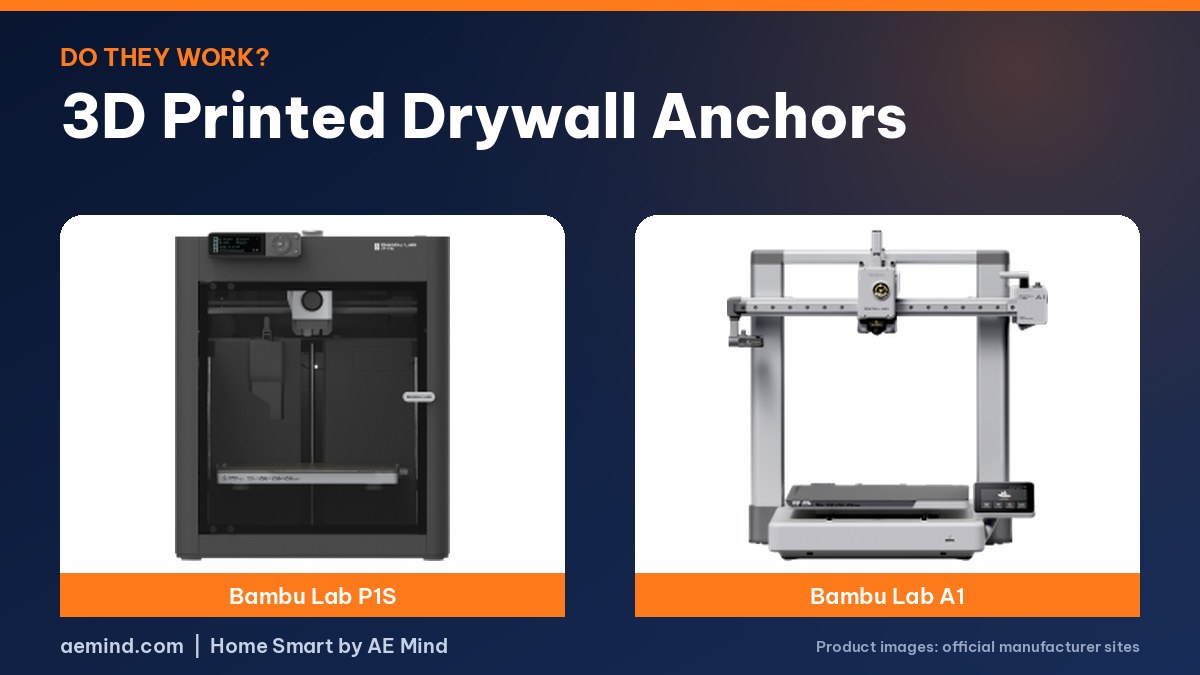
| Bambu Lab P1S Combo | $549.00 | Enclosed and consistent for PETG | Check price |
| Bambu Lab A1 | $299.99 | Prints PETG well in open air | Check price |
| Bambu Lab P2S Combo | $779.00 | Built-in filament drying for PETG | Check price |
3D Printed Drywall Anchors: Frequently Asked Questions
Do 3D printed drywall anchors work?
For light items, yes, in PETG and a print-friendly design. For heavy or important items, buy rated metal anchors.
PLA or PETG for anchors?
PETG. The Ptarmigan designer says PLA is too brittle and will break during installation.
How much weight can a printed anchor hold?
It varies a lot with design and print. One designer measured over 75 lb in a wall test but advises far less in use.
Can I use printed anchors on a ceiling?
No. Ceiling loads pull straight out; use rated toggles.
What is the strongest store-bought drywall anchor?
In Project Farm’s test, the Toggler SnapToggle BA, rated for 238 lb in drywall.
Sources
- Printables: Drywall Anchor by Ptarmigan
- Project Farm, “Which Drywall Anchor is Best? Let’s find out!”
- r/BambuLab: Would they work?
- r/functionalprint: Ran out of drywall anchors
- Amazon product listings for the printers linked above, October 16, 2026
Related: Useful Things to 3D Print for Your Home | 3D Prints for Garage Organization | PLA vs PETG for Beginners | How to 3D Print Replacement Parts
Notes and disclosure
Note: Printer prices come from Amazon listings on October 16, 2026 and change often. Load figures come from the Printables designer’s own test and Project Farm’s video; I have not load-tested these anchors. An earlier version cited a Vez3D video that turned out to be about bolting a printer to a wall, not drywall anchors; it has been removed.