
3D printed hinges work well for boxes, cases and lids, but for strength, a printed hinge with a metal screw as the pin outlasts a print-in-place design, according to Angus of Maker’s Muse, a YouTube channel about designing for 3D printing (Maker’s Muse, “Incredibly Handy 3D Printed Hinges!”). Print-in-place hinges are convenient but need clearance, which makes them looser.
Orientation matters as much as design. The center pin should lie in the plane of the layers, according to Gabe of Slant 3D, a print-farm company that publishes design-for-printing videos (Slant 3D, “How-to Design Print in Place Hinges”). Below are the main hinge types, the clearances creators use, how to print them and when to use metal instead.
Types of 3D Printed Hinges
Prices from Amazon at time of writing. I may earn a commission from links, at no cost to you.
| Type | Best for | Watch out for |
|---|---|---|
| Butt hinge with a metal screw pin | Durable lids and doors on small boxes | Needs the right screw size |
| Print-in-place pin hinge | Boxes, toys, articulated prints | Gaps fuse if clearance is too tight; looser fit |
| Snap hinge | Precise lids without fasteners | Wall thickness sets how tight it snaps |
| Nub or cone hinge | Snap-apart parts; printing on edge | Weaker when twisted |
| Living hinge (thin flexing strip) | Clips, flip caps | Very material dependent; PLA is a poor fit |
3D Printed Butt Hinges With a Screw
Maker’s Muse uses separately printed butt hinges with a screw as the pin “all the time,” calling them simple, robust and precise (Maker’s Muse, “Incredibly Handy 3D Printed Hinges!”). Because the parts print separately they can’t weld together, the metal pin outlasts plastic, and the halves come apart again if needed. The catch: anyone printing your shared design must find the same screw. In an earlier video he added that for hinges needing real strength, you can’t get away from fasteners, and suggested a screw with a nylock nut (Maker’s Muse, “How to design 3D Printable Hinges”).
Print-in-Place Hinges: Clearance and Shape
A print-in-place butt hinge bridges a plastic pin across the gap, so it’s ready to move straight off the bed and can never be separated. Maker’s Muse shared the settings that work for him (Maker’s Muse, “Incredibly Handy 3D Printed Hinges!”):
- Clearance: offset the faces by 0.3 mm, which works for decent printers with a 0.4 mm nozzle. Your printer may need more or less.
- Pin shape: give the pin a flat bottom so the bridge forms well.
- Bore shape: use a teardrop shape at the top with about a 70° overhang angle, so the overhang doesn’t droop and jam the movement.
- Size: make plastic pins chunky if the hinge needs strength.
He also noted print-in-place hinges are sloppier than screw-pinned ones because of the clearance they need. His earlier hinge video added that your printer’s bridging has to be good for a pin hinge to work (Maker’s Muse, “How to design 3D Printable Hinges”).
Snap Hinges and Nub Hinges
Snap hinges are printed in two parts and pushed together, relying on the plastic flexing into place. Maker’s Muse based his on injection-molding snap fasteners: a tapered interlock is easy to assemble but pulls apart with enough force, while 90° edges make a much stiffer hinge that’s harder to assemble (Maker’s Muse, “Incredibly Handy 3D Printed Hinges!”). Tuning offsets and wall thickness sets how tight it ends up.
Nub hinges swap the full pin for small interlocking spheres, as on injection-molded boxes. They print without supports, and with room for the plastic to flex, they can be snapped apart and back together (Maker’s Muse, “How to design 3D Printable Hinges”).
Orientation and Strength for 3D Printed Hinges
Slant 3D says a loop-and-rod hinge must be printed so its center pin lies in the plane of the layers; printed the other way, the loops can tear out along the layer lines (Slant 3D, “How-to Design Print in Place Hinges”). His other rule: keep these hinges chunky, because petite loops are the ones that snap off.
If a box must print on its edge, he showed a cone-shaped print-in-place hinge that stays captive with no side travel, though it is weaker when twisted, and a double-cone version with short cones of a couple of millimeters that avoids that leverage (Slant 3D, “How-to Design Print in Place Hinges”).
Living Hinges: Material Matters
Living hinges are the thin strips on flip-top caps. Maker’s Muse showed a small one printed in nylon that folds nicely, and noted that most plastics won’t do this unless modified to be flexible; even in injection molding they only last a limited number of bends (Maker’s Muse, “How to design 3D Printable Hinges”). Slant 3D warned that a PLA flat-sheet hinge bent too far will kink permanently and wear out, and recommends PETG, or a long loop if you must use PLA (Slant 3D, “How-to Design Print in Place Hinges”). He also showed a woodworking-style kerf pattern of many slots that lets a part twist into tight corners.
3D Printed Hinge Filament Guide
| Use | Filament | Why |
|---|---|---|
| Indoor, light load | PLA | Stiff and easy, but a poor choice for flexing |
| Pin hinges, flat flex hinges | PETG | Tougher and more flexible than PLA |
| Hot garage, car, outdoors | ASA | Heat and UV resistant; best in an enclosed printer |
| Living hinges | Nylon | Folds repeatedly in Maker’s Muse’s demo |
See PLA vs PETG for beginners for more on filament.
Best Printers for 3D Printed Hinges
| Printer | Price (Amazon, Oct 16, 2026) | Why it fits | Link |
|---|---|---|---|
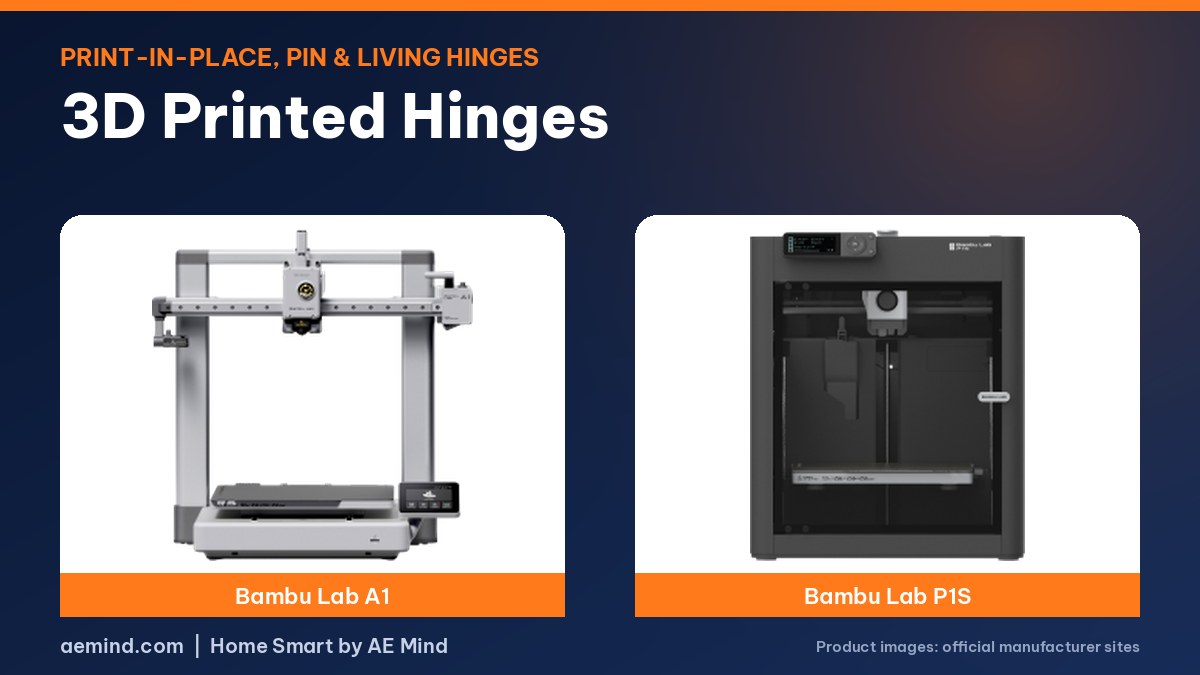
| Bambu Lab P1S Combo | $549.00 | Enclosed: handles PETG and ASA hardware | Check price |
| Bambu Lab A1 | $299.99 | Accurate auto-calibration for good-fitting parts | Check price |
| Elegoo Centauri 2 Combo | $328.99 | Enclosed CoreXY with 4-color at a lower price | Check price |
Video: Maker’s Muse, “Incredibly Handy 3D Printed Hinges!”. Embedded with credit.
Video: Slant 3D, “How-to Design Print in Place Hinges”.
3D Printed Hinges: Frequently Asked Questions
What clearance should a print-in-place hinge have?
Maker’s Muse uses a 0.3 mm offset with a 0.4 mm nozzle. Print a test hinge first, since printers vary.
Can 3D printed hinges hold a cabinet door?
Not reliably. Use metal hinges for doors and cabinets.
What is the best filament for 3D printed hinges?
PETG for durable pin and flex hinges; nylon for living hinges.
Which way should I print a hinge?
With the pin lying flat in the plane of the layers, per Slant 3D.
Why did my print-in-place hinge fuse?
Too little clearance, a drooping bore or over-extrusion. Increase the gap, use a teardrop bore or calibrate flow.
Sources
- Maker’s Muse, “How to design 3D Printable Hinges”
- Maker’s Muse, “Incredibly Handy 3D Printed Hinges!”
- Slant 3D, “How-to Design Print in Place Hinges”
- Amazon product listings for the printers linked above, October 16, 2026
Related: How to 3D Print Replacement Parts | 3D Printed Threads, Nuts and Bolts | PLA vs PETG for Beginners | 3D Printed Tools
Notes and disclosure
Note: Printer prices come from Amazon listings on October 16, 2026 and change often. Hinge designs and settings come from the credited YouTube creators; I have not tested these hinges myself.