
To price 3D prints to sell, add up the full landed cost (filament with waste, hardware, machine time, electricity, labor, packaging and fees), then add your margin. Filament alone is a poor guide to total cost.
That method lets Print Farm Academy, a YouTube channel about running print farms, charge about $55 for a part with about $4.90 of material. I Love 3D Printing, a YouTube channel that sells prints on Etsy, priced a real item the same way and landed at about $14.99, warning that undercutting everyone else creates distrust.
Important: Income figures in this post are claims made by the creators in their own videos. I have not verified them, and they are not typical results or a guarantee. Most small sellers earn far less, and many lose money in year one.
How to Price 3D Prints: The Formula
Prices checked on Amazon Oct 16, 2026. I may earn a commission from links, at no cost to you.
| Cost | How to figure it |
|---|---|
| Filament | Grams used (add about 10% for waste) times cost per gram |
| Extra parts | Magnets, screws, inserts |
| Machine cost | Printer price plus repairs, divided by expected print hours |
| Electricity | Printer watts times hours times your rate per kWh |
| Labor | Your time to prep, clean up and pack, times an hourly rate |
| Packaging | Box, padding, label, inserts |
| Fees | Etsy: 6.5% transaction fee plus payment processing and listing fees |
| Failure buffer | A small markup for failed prints |
Add those up for your true (landed) cost, then add your profit margin. Then compare with competitors and decide whether to compete or position as premium.
Worked Example (Illustrative)
Say a print uses 100 g of $20/kg filament ($2.00), runs 4 hours on a printer that costs about $0.10 an hour to own and power ($0.40), takes 15 minutes of work at $20/hour ($5.00) and $1.50 of packaging. That is about $8.90 before fees and failures. With a buffer and a healthy margin, you would price well above that, not at $9. These numbers are only an example; use your own.
Common Pricing Mistakes
- Only counting filament
- Forgetting to pay yourself
- Underpricing to beat competitors, which can signal low quality
- Ignoring Etsy fees and ad spend
- Not setting a minimum order price for tiny items
Printers That Keep Costs Down
| Printer | Price (Amazon, Oct 16, 2026) | Why it fits | Link |
|---|---|---|---|
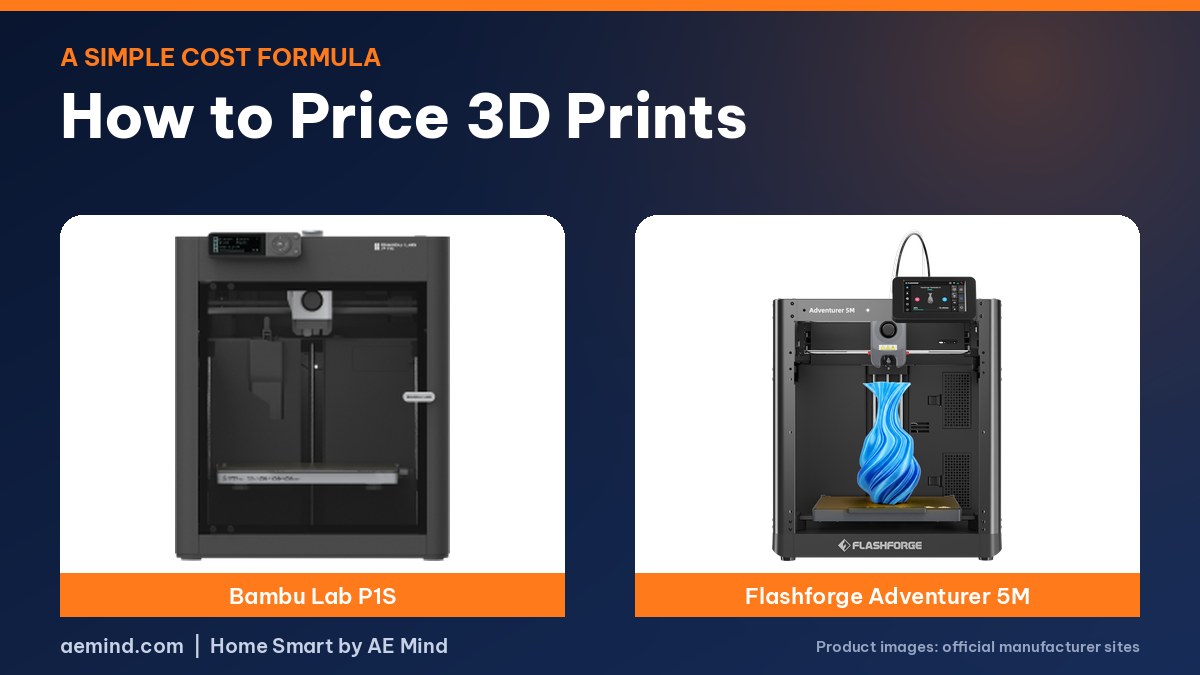
| Bambu Lab P1S Combo | $549.00 | Reliable, fewer failed prints | Check price |
| Flashforge Adventurer 5M | $249.00 | Low upfront cost per machine | Check price |
| Bambu Lab A1 | $299.99 | Low-cost, quiet; good for testing products | Check price |
What YouTube Creators Found About Pricing 3D Prints
These are findings from popular YouTube videos, paraphrased from their transcripts and credited. They are the creators’ experiences and claims, not my test results.
- Print Farm Academy (Print Farm Academy: “Why I charge $55 for this 3D printed part (how to price)”) explained why he charges about $55 for a part that uses about $4.90 of material. He builds a full “landed cost”: material with a 10% waste factor, purchased hardware, packaging, labor (he suggests $20/hour as a starting rate, roughly what an employee would cost) and machine cost. In his example, a $1,000 printer plus about $250 of repairs, spread over its expected run hours, plus electricity, comes to roughly 12 cents an hour before a buffer. He said filament cost is not a good indicator of total cost.
- I Love 3D Printing (I Love 3D Printing: “How I Price My 3D Prints – Full Cost Breakdown + Profit Margin”) walked through pricing a real Etsy item: filament, print-time electricity and wear, labor at his rate, packaging, Etsy fees and margin, landing at about $14.99. He warned that pricing below everyone else creates distrust and forces you to sell much more.
- On Reddit, one Etsy seller said they price by adding each cost layer separately and noted Etsy fees come to about 10 to 11% once transaction and payment processing are combined. Another works backwards from the highest realistic market price.
Frequently Asked Questions
How much should I charge per hour of 3D printing?
There is no standard. Calculate your machine and power cost per hour, then add labor and margin.
Should I charge by the gram?
Not by itself. Filament is often a small part of the real cost.
How much does Etsy take?
A 6.5% transaction fee plus payment processing and listing fees. Check Etsy’s current fee page.
Is there a 3D print price calculator?
Yes, several free calculators exist, and slicers like Bambu Studio show filament cost per print.
Sources
- Print Farm Academy: “Why I charge $55 for this 3D printed part”
- I Love 3D Printing: “How I Price My 3D Prints – Full Cost Breakdown + Profit Margin”
- r/3DprintEntrepreneurs: Etsy pricing workflow thread
- Etsy Fees & Payments Policy
- Amazon product listings for the printers linked above, October 16, 2026
Related: Bambu Lab A1 vs P1S | Best 3D Printer Under $500 | Do You Need a Filament Dryer?
Notes and disclosure
Note: Printer prices come from Amazon listings on October 16, 2026 and change often. The ideas below come from popular YouTube creators and Reddit threads, credited where used. My own hands-on results will be added after my planned test prints.
Affiliate Disclosure: If you purchase an item through the links on this page, I may receive a commission, at no additional cost to you. Thank you for supporting the channel.