
3D printed filament storage keeps spools dry only with a good seal, and one creator’s airtight dry box uses a U-shaped TPU insert in the lid and a removable desiccant compartment. That design comes from KellerLab, a YouTube channel about printable organization systems (KellerLab, “Stop Killing Your Filament: My (Almost) Perfect 3D-Printed Dry Rack”). He’s candid that no dry box keeps filament dry forever.
Lukis3D Studio, a 3D printing channel, printed 80 sealed boxes using about 27 kg of filament (Lukis3D Studio, “The ULTIMATE Filament Storage System”). Uncle Jessy, a 3D printing channel, built a wall rack holding 43 rolls per row for about $125 all-in (Uncle Jessy, “Easily the best 3D Printing Filament Storage Solutions”). Here are the main systems, what creators spent and tips to keep filament dry.
Types of 3D Printed Filament Storage
Prices from Amazon at time of writing. I may earn a commission from links, at no cost to you.
| System | Best for | Cost and time |
|---|---|---|
| Airtight printed dry boxes (TPU gasket and desiccant) | Moisture-sensitive filament | About 300 to 760 g of filament per box |
| Wall rod racks | Lots of PLA, visible colors | About $55 in hardware plus PETG |
| Stackable spool shelves | Small spaces | Low |
| Labels and color tags | Finding spools fast | Minutes |
KellerLab’s Dry Filament Rack
KellerLab designed his dry box to be fully printable and to fit his wall-mounted HomeRacker system (KellerLab, “Stop Killing Your Filament: My (Almost) Perfect 3D-Printed Dry Rack”). Its features:
- Seal: a lid with a U-shaped TPU insert that seals against the box rim.
- Desiccant compartment: detachable and slotted for airflow. Printed in polycarbonate, it can go in an oven at about 100°C to recharge the silica beads, though he notes that’s slower than the more common 150°C, and an oven that swings ±20°C can warp it. A small printed funnel helps refill it.
- Monitoring: lid cutouts for round or rectangular hygrometers.
- Labels: detachable plates you can print in the filament stored inside, for an instant color-coded inventory.
- Sizes: standard boxes fit spools up to 68 mm wide, and a jumbo version fits up to 72 mm.
His caveats: a standard box with its frame uses about 760 g of filament, which he puts at under €10 in PLA; the TPU seal is delicate to print and he has only tested Bambu TPU 95A HF; and you still need to watch humidity and recharge desiccant (KellerLab, “Stop Killing Your Filament: My (Almost) Perfect 3D-Printed Dry Rack”). For a cheaper option, he pointed to Moby Motion’s printable dry box, which skips TPU and uses less filament, though he hadn’t printed it himself.
Lukis3D Studio’s 80-Box Storage Wall
Lukis3D Studio printed each box in the color of the filament it holds, so he can spot it at a glance (Lukis3D Studio, “The ULTIMATE Filament Storage System”). The numbers:
- About 300 g and 6 hours per box; 80 boxes came to about 27 kg and 480 hours.
- TPU 95A high-flow gaskets at about 8 g and 40 minutes each.
- Eight screws per box for the clips, or 640 in all.
- About 70 g of desiccant per box, mixing colorless beads with color-changing beads that show when they need drying.
- Tags with a slider that marks remaining filament in 200 g steps.
He skipped the hygrometer version because each hole is another path for moisture, and brushed a water-based 3D print sealant inside each box as extra insurance.
Uncle Jessy’s Wall Rack
Uncle Jessy built a cleat-mounted wall rack from an open-source design, using printed cleats and brackets and 10 ft lengths of half-inch metal conduit (Uncle Jessy, “Easily the best 3D Printing Filament Storage Solutions”). He screwed 24 cleats into the studs across three rows, using a laser level, and found it easier to install cleats in vertical columns so they line up. Each row holds 43 rolls, roughly 113 lb, or almost 340 lb across the wall. He spent about $55 at Lowe’s on conduit and screws and about $70 on PETG, about $125 total. Open racks suit PLA you use often; moisture-sensitive filament still belongs in a sealed box.
How to Keep Filament Dry
- Use desiccant and recharge it when the indicator beads change color.
- A hygrometer helps, but every hole is a potential leak.
- Dry wet filament first; storage only keeps dry filament dry.
- Print gaskets in TPU and check the lid seals all around.
See do you need a filament dryer? for drying tips.
Best Printers for 3D Printed Filament Storage
| Printer | Price (Amazon, Oct 16, 2026) | Why it fits | Link |
|---|---|---|---|
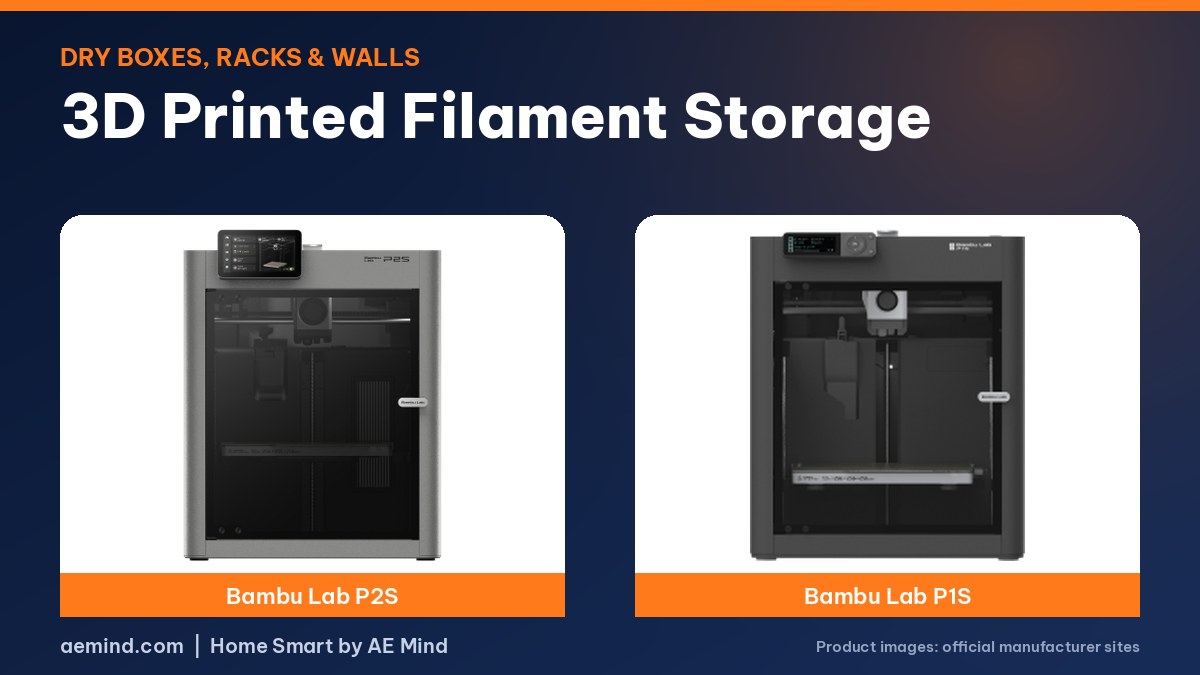
| Bambu Lab P2S Combo | $779.00 | Built-in filament drying | Check price |
| Bambu Lab P1S Combo | $549.00 | Enclosed workhorse for big batches | Check price |
| Bambu Lab A1 | $299.99 | Budget pick for PLA racks | Check price |
Video: KellerLab, “Stop Killing Your Filament: My (Almost) Perfect 3D-Printed Dry Rack”. Embedded with credit.
Video: Lukis3D Studio, “The ULTIMATE Filament Storage System”.
3D Printed Filament Storage: Frequently Asked Questions
Do 3D printed dry boxes stay airtight?
With TPU gaskets and well-printed lids they seal well, but KellerLab notes no dry box keeps filament dry forever.
What filament should I use for filament storage boxes?
PLA or PETG for boxes, TPU for gaskets and polycarbonate for an oven-safe desiccant holder.
Is 3D printed filament storage cheaper than buying?
For racks, often. Large dry-box systems use a lot of filament and time: Lukis3D Studio used about 27 kg for 80 boxes.
Do I still need a filament dryer?
Yes for wet filament. Storage keeps dry filament dry.
Sources
- KellerLab, “Stop Killing Your Filament: My (Almost) Perfect 3D-Printed Dry Rack”
- Lukis3D Studio, “The ULTIMATE Filament Storage System”
- Uncle Jessy, “Easily the best 3D Printing Filament Storage Solutions”
- Amazon product listings for the printers linked above, October 16, 2026
Related: Do You Need a Filament Dryer? | Gridfinity for Beginners | 3D Printed Pegboard Accessories | Bambu Lab A1 Maintenance Guide
Notes and disclosure
Note: Printer prices come from Amazon listings on October 16, 2026 and change often. Costs and print times come from the credited YouTube creators; I have not built these systems myself.