
3D printed threads work well at M6 and larger, but smaller sizes are better served by self-forming threads or heat-set inserts, according to Thomas Sanladerer of Made with Layers, a YouTube channel that rated each threading method for ease, strength and durability.
Tight fits are the most common problem. Sanford Prime, a YouTube channel that prints custom threaded parts, fixed them by adding clearance in the model, and Product Design Online, a Fusion 360 tutorial channel, prints three clearance tests to find the right fit.
This guide explains when to print threads, when to use metal hardware instead, and how to fix tight fits.
Ways to Add Threads to 3D Prints
Prices checked on Amazon Oct 16, 2026. I may earn a commission from links, at no cost to you.
| Method | Best for | Notes |
|---|---|---|
| Self-forming (screw into a plain hole) | Small screws up to about M5 | Hole size must be precise |
| Printed threads | About M6 and up, custom sizes | Need clearance; coarse threads print best |
| Heat-set inserts | Parts taken apart often | Metal-on-metal durability |
| Captive nuts | Easy strong joints | Hex pocket in the model |
| Thread repair inserts | Many threaded connections | Very strong |
Fixing Tight 3D Printed Threads
- Add clearance in your CAD model: Product Design Online prints test threads at different clearances.
- Sanford Prime found his first threads had too little clearance because printed lines squish, so he opened up the clearance in the model.
- Print threads vertically for the best profile.
- Calibrate flow and avoid elephant foot.
3D Printed Nuts and Bolts: Uses and Limits
Printed bolts are fine for custom sizes, knobs, jar lids and fidgets, but they are far weaker than steel. Use metal fasteners for anything structural. A printed nut-and-bolt sorter or gauge is a great way to organize real hardware; see Gridfinity guide.
| Use | Filament | Why |
|---|---|---|
| Indoor holders and organizers | PLA | Easy, stiff, cheap |
| Parts that get dropped or flexed | PETG | Tougher, less brittle |
| Hot garage, truck or van | ASA (or ABS) | Higher heat resistance; needs an enclosed printer |
| Soft jaws, grips, non-marring tips | TPU | Rubber-like, will not scratch |
Best Printers for Precise Threads
| Printer | Price (Amazon, Oct 16, 2026) | Why it fits | Link |
|---|---|---|---|
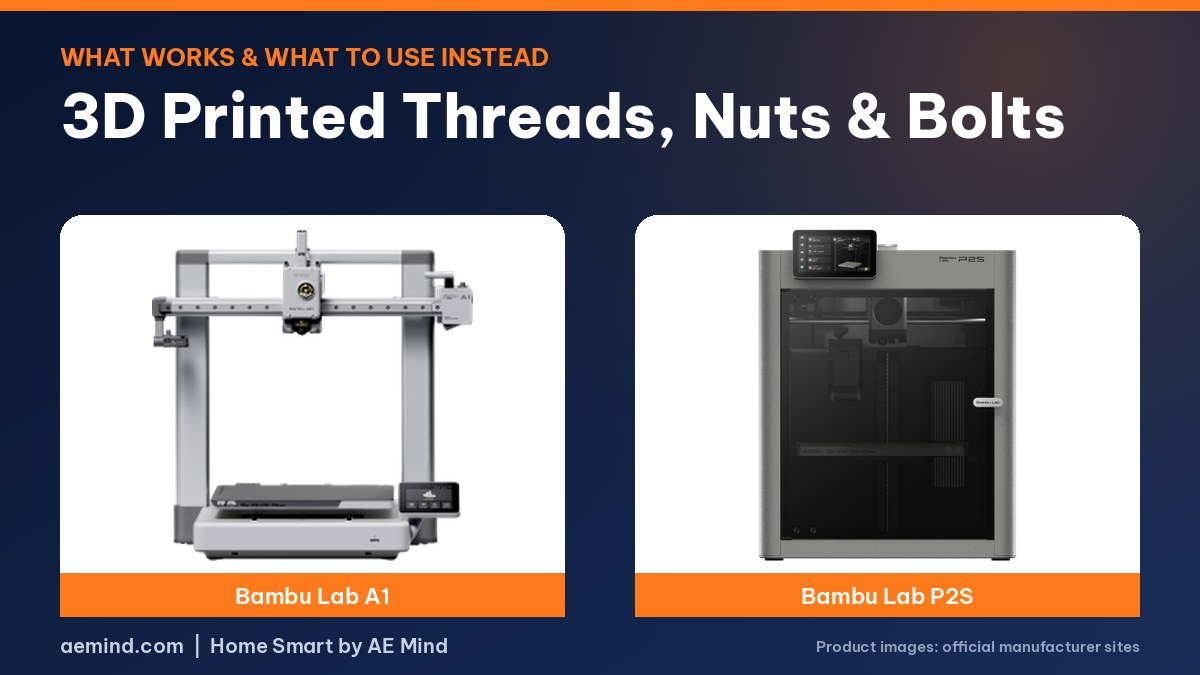
| Bambu Lab A1 | $299.99 | Accurate auto-calibration for good thread fit | Check price |
| Bambu Lab P2S Combo | $779.00 | Enclosed for PETG and ASA threaded parts | Check price |
| Bambu Lab P1S Combo | $549.00 | Enclosed workhorse for functional parts | Check price |
What YouTube Creators Found About 3D Printed Threads
These are findings from popular YouTube videos, paraphrased from their transcripts and credited. They are the creators’ experiences and claims, not my test results.
- Thomas Sanladerer (Made with Layers (Thomas Sanladerer): “A better way to add threads to your 3D prints”) rated each method for ease, strength and durability. He said a plain hole is the easiest to design but hardest to get right, because M3 screws strip if the hole is slightly large. He finds printed threads work well only around M6 and larger. His own approach: self-forming threads up to about M5, printed threads beyond that, and heat-set inserts or thread repair inserts when he needs more strength.
- Product Design Online (Product Design Online: “3D Printed Threads – Model Them in Fusion 360”) shows modeling internal and external threads in Fusion 360 and printing three clearance tests so you can see which fits.
- Sanford Prime (Sanford Prime: “How To 3D Print Perfect Threads”) prints custom threaded parts he can’t buy, like large nuts for a rifle rest. He fixed tight fits by adding clearance in the model rather than chasing the threads afterwards.
Modeling Threads in Fusion 360
Frequently Asked Questions
Why are my 3D printed threads too tight?
Not enough clearance. Add 0.2 to 0.4 mm in the model, or use a coarser pitch.
Can you 3D print nuts and bolts?
Yes, for light duty and custom sizes. Use steel for anything structural.
Heat-set inserts or printed threads?
Inserts for parts you open often or that need strength; printed threads for large or custom sizes.
What is the smallest thread you can print?
On FDM, about M6 prints reliably, per Thomas Sanladerer. Resin does finer.
Sources
- Made with Layers (Thomas Sanladerer): “A better way to add threads to your 3D prints”
- Product Design Online: “3D Printed Threads – Model Them in Fusion 360”
- Sanford Prime: “How To 3D Print Perfect Threads”
- Aladdin’s Lab: “How to Make PERFECT Threads in Bambu Studio”
- Amazon product listings for the printers linked above, October 16, 2026
Related: How to 3D Print Replacement Parts | PLA vs PETG for Beginners | Gridfinity for Beginners | Bambu Lab A1 Review
Notes and disclosure
Note: Printer prices come from Amazon listings on October 16, 2026 and change often. The ideas below come from popular YouTube creators and Reddit threads, credited where used. My own hands-on results will be added after my planned test prints.
Affiliate Disclosure: If you purchase an item through the links on this page, I may receive a commission, at no additional cost to you. Thank you for supporting the channel.